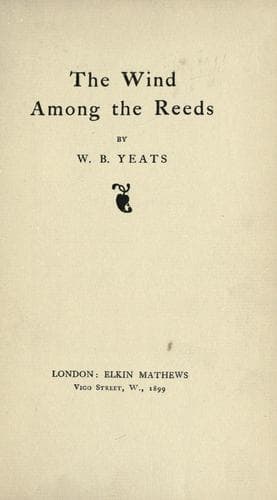
The Wind Among the ReedsYeats, W. B. (William Butler)
General
The Wind Among the Reeds
Yeats, W. B. (William Butler)
English poetry -- Irish authors
This woman was drowned; but more often the persons who are taken 'get
the touch,' as it is called, and fall into a half dream, and grow
indifferent to all things, for their true life has gone out of the
world, and is among the hills and the forts of the Sidhe. A faery doctor
has told me that his wife 'got the touch' at her marriage because there
was one of them wanted her; and the way he knew for certain was, that
when he took a pitchfork out of the rafters, and told her it was a
broom, she said, 'It is a broom.' She was, the truth is, in the magical
sleep, to which people have given a new name lately, that makes the
imagination so passive that it can be moulded by any voice in any world
into any shape. A mere likeness of some old woman, or even old animal,
some one or some thing the Sidhe have no longer a use for, is believed
to be left instead of the person who is 'away;' this some one or some
thing can, it is thought, be driven away by threats, or by violence
(though I have heard country women say that violence is wrong), which
perhaps awakes the soul out of the magical sleep. The story in the poem
is founded on an old Gaelic ballad that was sung and translated for me
by a woman at Ballisodare in County Sligo; but in the ballad the husband
found the keeners keening his wife when he got to his house. She was
'swept' at once; but the Sidhe are said to value those the most whom
they but cast into a half dream, which may last for years, for they need
the help of a living person in most of the things they do. There are
many stories of people who seem to die and be buried--though the country
people will tell you it is but some one or some thing put in their place
that dies and is buried--and yet are brought back afterwards. These
tales are perhaps memories of true awakenings out of the magical sleep,
moulded by the imagination, under the influence of a mystical doctrine
which it understands too literally, into the shape of some well-known
traditional tale. One does not hear them as one hears the others, from
the persons who are 'away,' or from their wives or husbands; and one old
man, who had often seen the Sidhe, began one of them with 'Maybe it is
all vanity.'
Here is a tale that a friend of mine heard in the Burren hills, and it
is a type of all:--
Public-domain text, read in full here on John Shaqi.
Reviews
Reviews
No reviews yet
Be the first to share your thoughts on this work.
Join the Discussion
Join the discussion
Sign in to leave a comment or review.
Sign InorCreate an account