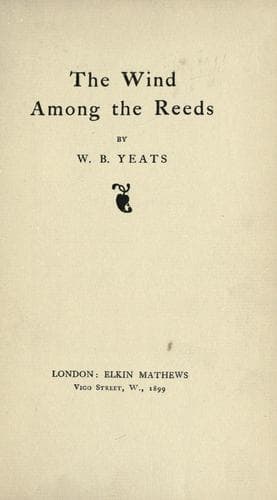
The Wind Among the ReedsYeats, W. B. (William Butler)
General
The Wind Among the Reeds
Yeats, W. B. (William Butler)
English poetry -- Irish authors
I find that I have unintentionally changed the old story of Conchobar's
death. He did not see the crucifixion in a vision, but was told about
it. He had been struck by a ball, made of the dried brain of a dead
enemy, and hurled out of a sling; and this ball had been left in his
head, and his head had been mended, the Book of Leinster says, with
thread of gold because his hair was like gold. Keating, a writer of the
time of Elizabeth, says, 'In that state did he remain seven years, until
the Friday on which Christ was crucified, according to some historians;
and when he saw the unusual changes of the creation and the eclipse of
the sun and the moon at its full, he asked of Bucrach, a Leinster
Druid, who was along with him, what was it that brought that unusual
change upon the planets of Heaven and Earth. "Jesus Christ, the son of
God," said the Druid, "who is now being crucified by the Jews." "That is
a pity," said Conchobar; "were I in his presence I would kill those who
were putting him to death." And with that he brought out his sword, and
rushed at a woody grove which was convenient to him, and began to cut
and fell it; and what he said was, that if he were among the Jews that
was the usage he would give them, and from the excessiveness of his fury
which seized upon him, the ball started out of his head, and some of the
brain came after it, and in that way he died. The wood of Lanshraigh, in
Feara Rois, is the name by which that shrubby wood is called.'
I have imagined Cuchullain meeting Fand 'walking among flaming dew.' The
story of their love is one of the most beautiful of our old tales. Two
birds, bound one to another with a chain of gold, came to a lake side
where Cuchullain and the host of Uladh was encamped, and sang so sweetly
that all the host fell into a magic sleep. Presently they took the shape
of two beautiful women, and cast a magical weakness upon Cuchullain, in
which he lay for a year. At the year's end an Aengus, who was probably
Aengus the master of love, one of the greatest of the children of the
goddess Danu, came and sat upon his bedside, and sang how Fand, the wife
of Mannannan, the master of the sea, and of the islands of the dead,
loved him; and that if he would come into the country of the gods, where
there was wine and gold and silver, Fand, and Laban her sister, would
heal him of his magical weakness. Cuchullain went to the country of the
gods, and, after being for a month the lover of Fand, made her a
promise to meet her at a place called 'the Yew at the Strand's End,' and
came back to the earth. Emer, his mortal wife, won his love again, and
Mannannan came to 'the Yew at the Strand's End,' and carried Fand away.
When Cuchullain saw her going, his love for her fell upon him again, and
he went mad, and wandered among the mountains without food or drink,
until he was at last cured by a Druid drink of forgetfulness.
Public-domain text, read in full here on John Shaqi.
Reviews
Reviews
No reviews yet
Be the first to share your thoughts on this work.
Join the Discussion
Join the discussion
Sign in to leave a comment or review.
Sign InorCreate an account