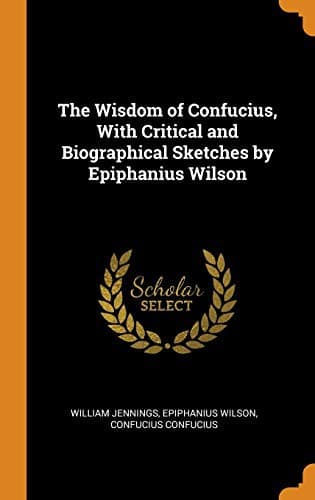
The Wisdom of Confucius: with Critical and Biographical Sketches — John Shaqi
The Wisdom of Confucius: with Critical and Biographical SketchesConfucius
ReligionEastern
The Wisdom of Confucius: with Critical and Biographical Sketches
Confucius
Ethics -- China; Philosophy, Chinese
An observation of Tsz-yu:--
"Officiousness, in the service of princes, leads to disgrace; among
friends, to estrangement."
BOOK V
_A Disciple and the Golden Rule--Miscellaneous_
The Master pronounced Kung-ye Ch‘ang, a disciple, to be a
marriageable person; for although lying bound in criminal fetters he
had committed no crime. And he gave him his own daughter to wife.
Of Nan Yung, a disciple, he observed, that in a State where the
government was well conducted he would not be passed over in its
appointments, and in one where the government was ill conducted he
would evade punishment and disgrace. And he caused his elder brother's
daughter to be given in marriage to him.
Of Tsz-tsien, a disciple, he remarked, "A superior man indeed is the
like of him! But had there been none of superior quality in Lu, how
should this man have attained to this excellence?"
Tsz-kung asked, "What of me, then?" "You," replied the Master--"You
are a receptacle." "Of what sort?" said he. "One for high and sacred
use," was the answer.
Some one having observed of Yen Yung that he was good-natured towards
others, but that he lacked the gift of ready speech, the Master said,
"What need of that gift? To stand up before men and pour forth a stream
of glib words is generally to make yourself obnoxious to them. I know
not about his good-naturedness; but at any rate what need of that gift?"
When the Master proposed that Tsi-tiau K‘ai should enter the
government service, the latter replied, "I can scarcely credit it."
The Master was gratified.
"Good principles are making no progress," once exclaimed the Master.
"If I were to take a raft, and drift about on the sea, would Tsz-lu, I
wonder, be my follower there?" That disciple was delighted at hearing
the suggestion; whereupon the Master continued, "He surpasses me in
his love of deeds of daring. But he does not in the least grasp the
pith of my remark."
In reply to a question put to him by Mang Wu respecting Tsz-lu--as to
whether he might be called good-natured towards others, the Master
said, "I cannot tell"; but, on the question being put again, he
answered, "Well, in an important State[10] he might be intrusted with
the management of the military levies; but I cannot answer for his
good nature."
"What say you then of Yen Yu?"
"As for Yen," he replied, "in a city of a thousand families, or in a
secondary fief,[11] he might be charged with the governorship; but I
cannot answer for his good-naturedness."
"Take Tsz-hwa, then; what of him?"
"Tsz-hwa," said he, "with a cincture girt upon him, standing as
attendant at Court, might be charged with the addressing of visitors
and guests; but as to his good-naturedness I cannot answer."
Addressing Tsz-kung, the Master said, "Which of the two is ahead of
the other--yourself or Hwúi?" "How shall I dare," he replied, "even to
look at Hwúi? Only let him hear one particular, and from that he knows
ten; whereas I, if I hear one, may from it know two."
Public-domain text, read in full here on John Shaqi.
Reviews
Reviews
No reviews yet
Be the first to share your thoughts on this work.
Join the Discussion
Join the discussion
Sign in to leave a comment or review.
Sign InorCreate an account