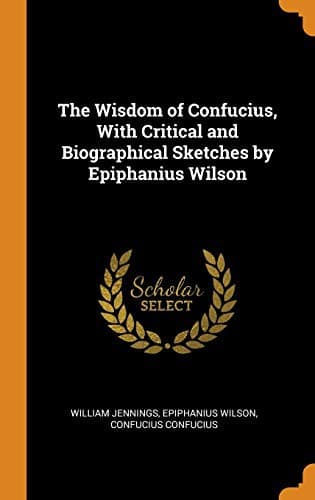
The Wisdom of Confucius: with Critical and Biographical Sketches — John Shaqi
The Wisdom of Confucius: with Critical and Biographical SketchesConfucius
ReligionEastern
The Wisdom of Confucius: with Critical and Biographical Sketches
Confucius
Ethics -- China; Philosophy, Chinese
The disciple went on to say:--"After the assassination of the prince
of Ts‘i by the officer Ts‘ui, the latter's fellow-official Ch‘in
Wan, who had half a score teams of horses, gave up all, and turned his
back upon him. On coming to another State, he observed, 'There are
here characters somewhat like that of our minister Ts‘ui,' and he
turned his back upon them. Proceeding to a certain other State, he had
occasion to make the same remark, and left. What say you of him?"
"That he was a pure-minded man," answered the Master.
"But was he a man of fellow-feeling?" urged the disciple.
"Of that I am not sure," he replied; "how am I to get at that?"
Ki Wan was one who thought three times over a thing before he acted.
The Master hearing this of him, observed, "Twice would have been
enough."
Of Ning Wu, the Master said that when matters went well in the State
he used to have his wits about him: but when they went wrong, he lost
them. His intelligence might be equalled, but not his witlessness!
Once, when the Master lived in the State of Ch‘in, he exclaimed,
"Let me get home again! Let me get home! My school-children[13] are
wild and impetuous! Though they are somewhat accomplished, and perfect
in one sense in their attainments, yet they know not how to make nice
discriminations."
Of Peh-I and Shuh Ts‘i he said, "By the fact of their not
remembering old grievances, they gradually did away with resentment."
Of Wei-shang Kau he said, "Who calls him straightforward? A person
once begged some vinegar of him, and he begged it from a neighbor, and
then presented him with it!"
"Fine speech," said he, "and studied mien, and superfluous show of
deference--of such things Tso-k‘iu Ming was ashamed. I too am
ashamed of such things. Also of hiding resentment felt towards an
opponent and treating him as a friend--of this kind of thing he was
ashamed, and so too am I."
Attended once by the two disciples Yen Yuen and Tsz-lu, he said, "Come
now, why not tell me, each of you, what in your hearts you are really
after?"
"I should like," said Tsz-lu, "for myself and my friends and
associates, carriages and horses, and to be clad in light furs! nor
would I mind much if they should become the worse for wear."
"And I should like," said Yen Yuen, "to live without boasting of my
abilities, and without display of meritorious deeds."
Tsz-lu then said, "I should like, sir, to hear what your heart is set
upon."
The Master replied, "It is this:--in regard to old people, to give
them quiet and comfort; in regard to friends and associates, to be
faithful to them; in regard to the young, to treat them with fostering
affection and kindness."
On one occasion the Master exclaimed, "Ah, 'tis hopeless! I have not
yet seen the man who can see his errors, so as inwardly to accuse
himself."
"In a small cluster of houses there may well be," said he, "some whose
integrity and sincerity may compare with mine; but I yield to none in
point of love of learning."
Public-domain text, read in full here on John Shaqi.
Reviews
Reviews
No reviews yet
Be the first to share your thoughts on this work.
Join the Discussion
Join the discussion
Sign in to leave a comment or review.
Sign InorCreate an account