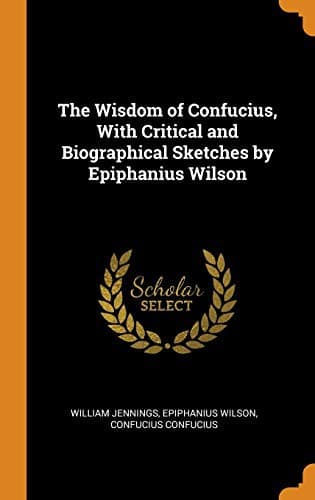
The Wisdom of Confucius: with Critical and Biographical Sketches — John Shaqi
The Wisdom of Confucius: with Critical and Biographical SketchesConfucius
ReligionEastern
The Wisdom of Confucius: with Critical and Biographical Sketches
Confucius
Ethics -- China; Philosophy, Chinese
Again he said: "The man that is capable of being intrusted with the
charge of a minor on the throne, and given authority over a large
territory, and who, during the important term of his superintendence
cannot be forced out of his position, is not such a 'superior man'?
That he is, indeed."
Again:--"The learned official must not be without breadth and power of
endurance: the burden is heavy, and the way is long.
"Suppose that he take his duty to his fellow-men as his peculiar
burden, is that not indeed a heavy one? And since only with death it
is done with, is not the way long?"
Sentences of the Master:--
"From the 'Book of Odes' we receive impulses; from the 'Book of the
Rules,' stability; from the 'Book on Music,' refinement.[20]
"The people may be put into the way they should go, though they may
not be put into the way of understanding it.
"The man who likes bravery, and yet groans under poverty, has mischief
in him. So, too, has the misanthrope, groaning at any severity shown
towards him.
"Even if a person were adorned with the gifts of the Duke of Chow, yet
if he were proud and avaricious, all the rest of his qualities would
not indeed be worth looking at.
"Not easily found is the man who, after three years' study, has failed
to come upon some fruit of his toil.
"The really faithful lover of learning holds fast to the Good Way till
death.
"He will not go into a State in which a downfall is imminent, nor take
up his abode in one where disorder reigns. When the empire is well
ordered he will show himself; when not, he will hide himself away.
Under a good government it will be a disgrace to him if he remain in
poverty and low estate; under a bad one, it would be equally
disgraceful to him to hold riches and honors.
"If not occupying the office, devise not the policy.
"When the professor Chi began his duties, how grand the finale of the
First of the Odes used to be! How it rang in one's ears!
"I cannot understand persons who are enthusiastic and yet not
straightforward; nor those who are ignorant and yet not attentive; nor
again those folks who are simple-minded and yet untrue.
"Learn, as if never overtaking your object, and yet as if apprehensive
of losing it.
"How sublime was the handling of the empire by Shun and Yu!--it was as
nothing to them!
"How great was Yau as a prince! Was he not sublime! Say that Heaven
only is great, then was Yau alone after its pattern! How profound was
he! The people could not find a name for him. How sublime in his
achievements! How brilliant in his scholarly productions!"
Shun had for his ministers five men, by whom he ordered the empire.
King Wu (in his day) stated that he had ten men as assistants for the
promotion of order.
Public-domain text, read in full here on John Shaqi.
Reviews
Reviews
No reviews yet
Be the first to share your thoughts on this work.
Join the Discussion
Join the discussion
Sign in to leave a comment or review.
Sign InorCreate an account