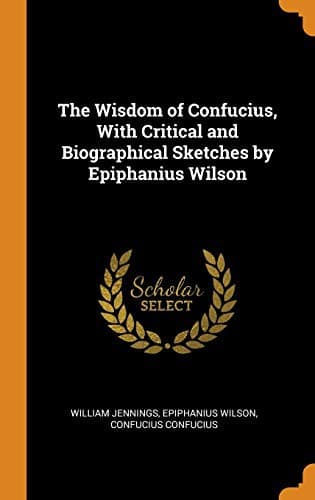
The Wisdom of Confucius: with Critical and Biographical SketchesConfucius
ReligionEastern
The Wisdom of Confucius: with Critical and Biographical Sketches
Confucius
Ethics -- China; Philosophy, Chinese
When he presented the gifts of ceremony, he would assume a placid
expression of countenance. At the private interview he would be
cordial and affable.
The good man would use no purple or violet colors for the facings of
his dress.[22] Nor would he have red or orange color for his
undress.[23] For the hot season he wore a singlet, of either coarse or
fine texture, but would also feel bound to have an outer garment
covering it. For his black robe he had lamb's wool; for his white one,
fawn's fur; and for his yellow one, fox fur. His furred undress robe
was longer, but the right sleeve was shortened. He would needs have
his sleeping-dress one and a half times his own length. For ordinary
home wear he used thick substantial fox or badger furs. When he left
off mourning, he would wear all his girdle trinkets. His kirtle in
front, when it was not needed for full cover, he must needs have cut
down. He would never wear his (black) lamb's-wool, or a dark-colored
cap, when he went on visits of condolence to mourners.[24] On the
first day of the new moon, he must have on his Court dress and to
Court. When observing his fasts, he made a point of having bright,
shiny garments, made of linen. He must also at such times vary his
food, and move his seat to another part of his dwelling-room.
As to his food, he never tired of rice so long as it was clean and
pure, nor of hashed meats when finely minced. Rice spoiled by damp,
and sour, he would not touch, nor tainted fish, nor bad meat, nor
aught of a bad color or smell, nor aught overdone in cooking, nor
aught out of season. Neither would he eat anything that was not
properly cut, or that lacked its proper seasonings. Although there
might be an abundance of meat before him, he would not allow a
preponderance of it to rob the rice of its beneficial effect in
nutrition. Only in the matter of wine did he set himself no limit, yet
he never drank so much as to confuse himself. Tradesmen's wines, and
dried meats from the market, he would not touch. Ginger he would never
have removed from the table during a meal. He was not a great eater.
Meat from the sacrifices at the prince's temple he would never put
aside till the following day. The meat of his own offerings he would
never give out after three days' keeping, for after that time none
were to eat it.
At his meals he would not enter into discussions; and when reposing
(afterwards) he would not utter a word.
Even should his meal consist only of coarse rice and vegetable broth
or melons, he would make an offering, and never fail to do so
religiously.
He would never sit on a mat that was not straight.
After a feast among his villagers, he would wait before going away
until the old men had left.
When the village people were exorcising the pests, he would put on his
Court robes and stand on the steps of his hall to receive them.
When he was sending a message of inquiry to a person in another State,
he would bow twice on seeing the messenger off.
Public-domain text, read in full here on John Shaqi.
Reviews
Reviews
No reviews yet
Be the first to share your thoughts on this work.
Join the Discussion
Join the discussion
Sign in to leave a comment or review.
Sign InorCreate an account