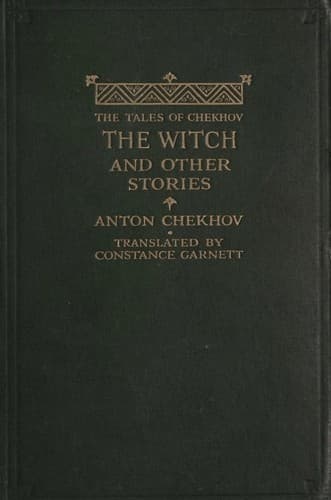
The Witch, and Other StoriesChekhov, Anton Pavlovich
General
The Witch, and Other Stories
Chekhov, Anton Pavlovich
Chekhov, Anton Pavlovich, 1860-1904 -- Translations into English; Russia -- Social life and customs -- Fiction; Short stories
When Osip came into the village elder’s hut with his tax book, the
police inspector, a lean old man with a long grey beard, in a grey
tunic, was sitting at a table in the passage, writing something. It was
clean in the hut; all the walls were dotted with pictures cut out of
the illustrated papers, and in the most conspicuous place near the ikon
there was a portrait of the Battenburg who was the Prince of Bulgaria.
By the table stood Antip Syedelnikov with his arms folded.
“There is one hundred and nineteen roubles standing against him,” he
said when it came to Osip’s turn. “Before Easter he paid a rouble, and
he has not paid a kopeck since.”
The police inspector raised his eyes to Osip and asked:
“Why is this, brother?”
“Show Divine mercy, your honour,” Osip began, growing agitated. “Allow
me to say last year the gentleman at Lutorydsky said to me, ‘Osip,’ he
said, ‘sell your hay... you sell it,’ he said. Well, I had a hundred
poods for sale; the women mowed it on the water-meadow. Well, we struck
a bargain all right, willingly....”
He complained of the elder, and kept turning round to the peasants
as though inviting them to bear witness; his face flushed red and
perspired, and his eyes grew sharp and angry.
“I don’t know why you are saying all this,” said the police inspector.
“I am asking you... I am asking you why you don’t pay your arrears. You
don’t pay, any of you, and am I to be responsible for you?”
“I can’t do it.”
“His words have no sequel, your honour,” said the elder. “The
Tchikildyeevs certainly are of a defective class, but if you will just
ask the others, the root of it all is vodka, and they are a very bad
lot. With no sort of understanding.”
The police inspector wrote something down, and said to Osip quietly, in
an even tone, as though he were asking him for water:
“Be off.”
Soon he went away; and when he got into his cheap chaise and cleared his
throat, it could be seen from the very expression of his long thin back
that he was no longer thinking of Osip or of the village elder, nor of
the Zhukovo arrears, but was thinking of his own affairs. Before he had
gone three-quarters of a mile Antip was already carrying off the samovar
from the Tchikildyeevs’ cottage, followed by Granny, screaming shrilly
and straining her throat:
“I won’t let you have it, I won’t let you have it, damn you!”
He walked rapidly with long steps, and she pursued him panting, almost
falling over, a bent, ferocious figure; her kerchief slipped on to her
shoulders, her grey hair with greenish lights on it was blown about in
the wind. She suddenly stopped short, and like a genuine rebel, fell
to beating her breast with her fists and shouting louder than ever in a
sing-song voice, as though she were sobbing:
“Good Christians and believers in God! Neighbours, they have ill-treated
me! Kind friends, they have oppressed me! Oh, oh! dear people, take my
part.”
“Granny, Granny!” said the village elder sternly, “have some sense in
your head!”
Public-domain text, read in full here on John Shaqi.
Reviews
Reviews
No reviews yet
Be the first to share your thoughts on this work.
Elsewhere in the archive
Join the Discussion
Join the discussion
Sign in to leave a comment or review.
Sign InorCreate an account