Produced by Dagny; John Bickers
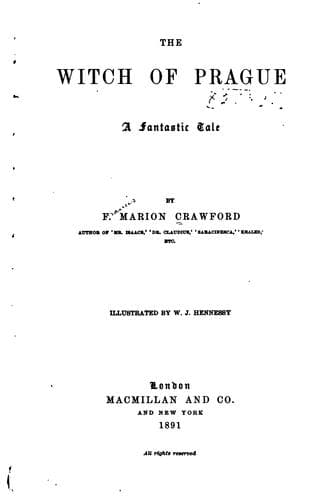
THE WITCH OF PRAGUE
A FANTASTIC TALE
By F. Marion Crawford
CHAPTER I
A great multitude of people filled the church, crowded together in
the old black pews, standing closely thronged in the nave and aisles,
pressing shoulder to shoulder even in the two chapels on the right and
left of the apse, a vast gathering of pale men and women whose eyes
were sad and in whose faces was written the history of their nation. The
mighty shafts and pilasters of the Gothic edifice rose like the stems of
giant trees in a primeval forest from a dusky undergrowth, spreading out
and uniting their stony branches far above in the upper gloom. From the
clerestory windows of the nave an uncertain light descended halfway to
the depths and seemed to float upon the darkness below as oil upon the
water of a well. Over the western entrance the huge fantastic organ
bristled with blackened pipes and dusty gilded ornaments of colossal
size, like some enormous kingly crown long forgotten in the lumber
room of the universe, tarnished and overlaid with the dust of ages.
Eastwards, before the rail which separated the high altar from the
people, wax torches, so thick that a man might not span one of them with
both his hands, were set up at irregular intervals, some taller, some
shorter, burning with steady, golden flames, each one surrounded with
heavy funeral wreaths, and each having a tablet below it, whereon were
set forth in the Bohemian idiom, the names, titles, and qualities of
him or her in whose memory it was lighted. Innumerable lamps and tapers
before the side altars and under the strange canopied shrines at the
bases of the pillars, struggled ineffectually with the gloom, shedding
but a few sickly yellow rays upon the pallid faces of the persons
nearest to their light.
Suddenly the heavy vibration of a single pedal note burst from the
organ upon the breathing silence, long drawn out, rich, voluminous,
and imposing. Presently, upon the massive bass, great chords grew up,
succeeding each other in a simple modulation, rising then with the
blare of trumpets and the simultaneous crash of mixtures, fifteenths
and coupled pedals to a deafening peal, then subsiding quickly again
and terminating in one long sustained common chord. And now, as the
celebrant bowed at the lowest step before the high altar, the voices of
the innumerable congregation joined the harmony of the organ, ringing
up to the groined roof in an ancient Slavonic melody, melancholy
and beautiful, and rendered yet more unlike all other music by the
undefinable character of the Bohemian language, in which tones softer
than those of the softest southern tongue alternate so oddly with rough
gutturals and strident sibilants.
Public-domain text, read in full here on John Shaqi.
Reviews
Reviews
No reviews yet
Be the first to share your thoughts on this work.
Join the Discussion
Join the discussion
Sign in to leave a comment or review.
Sign InorCreate an account