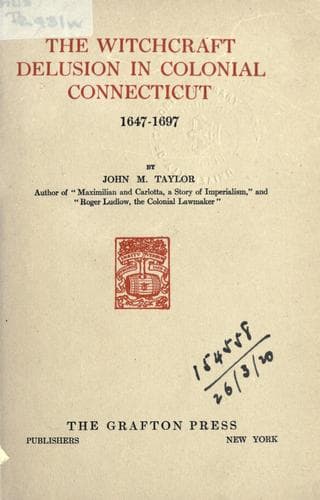
The Witchcraft Delusion in Colonial Connecticut (1647-1697)Taylor, John M. (John Metcalf)
History
The Witchcraft Delusion in Colonial Connecticut (1647-1697)
Taylor, John M. (John Metcalf)
Connecticut -- History -- Colonial period, ca. 1600-1775; Witchcraft -- Connecticut -- History
private to her sister a little before & to no other.) Mary replied she
feared her not, because God had kept her & would keep her still. The
voice said she had a commission to kill her. Mary asked, Who gave you
the commission? The voice replied God gave me the commission. Mary
replied, The Devil is a liar from the beginning for God will not give
commission to murder, therefore it must be from the devil. Then Mary was
again pressed very much. Then the voice said, You will make known these
things abroad when I am gone, but if you will promise me to keep these
aforesaid matters secret I will come no more to afflict you. Mary
replied I will tell it abroad. Whereas the said Mary mentions divers
times in this former writing that she heard a voice, this said Mary
affirmeth that she did & doth know that it was the voice of Katherine
Harrison aforesaid; and Mary aforesaid affirmeth that the substance of
the whole relation is truth." Sworn in Court May 25, 1669. Attest John
Allyn, Sec'y.
Elizabeth Smith--_Neighborly criticism--Fortune telling--Spinning yarn_
"Elizabeth the wife of Simon Smith of Thirty Mile Island testified that
Catherine was noted by her and the rest of the family to be a great or
notorious liar, a sabbath breaker, and one that told fortunes, and told
the said Elizabeth her fortune, that her husband's name should be Simon;
& also told the said Elizabeth some other matters that did come to pass;
and also would oft speak and boast of her great familiarity with Mr.
Lilley, one that told fortunes and foretold many matters that in furture
times were to be accomplished. And also the said Katherine did often
spin so great a quantity of fine linen yarn as the said Elizabeth did
never know nor hear of any other woman that could spin so much. And
further, the said Elizabeth said that Capt. Cullick observing the evil
conversation in word and deed of the said Katherine turned her out of
his service, one reason was because the said Katherine told fortunes."
Taken upon oath Sept. 23, 1668 before John Allyn, Assistant.
On such evidence, October 12, 1669, the jury being called to give in
their verdict upon the indictment of Katherine Harrison, returned that
they find the prisoner guilty of the indictment.
But meanwhile important things in the history of the case had come to
pass. Serious doubts arose in the minds of the magistrates as to
accepting the verdict, and in their dilemma they took counsel not only
of the law but of the gospel, and presented a series of questions to
certain ministers--the same expedient adopted by the court at Salem
twenty-three years later.
The answer of the ministers is in the handwriting of Rev. Gershom
Bulkeley of Wethersfield, the author of the unique treatise _Will and
Doom_. It was a remarkable paper as to preternatural apparitions, the
character of evidence for conviction, and its cautions as to its
acceptance. It was this:
Public-domain text, read in full here on John Shaqi.
Reviews
Reviews
No reviews yet
Be the first to share your thoughts on this work.
Join the Discussion
Join the discussion
Sign in to leave a comment or review.
Sign InorCreate an account