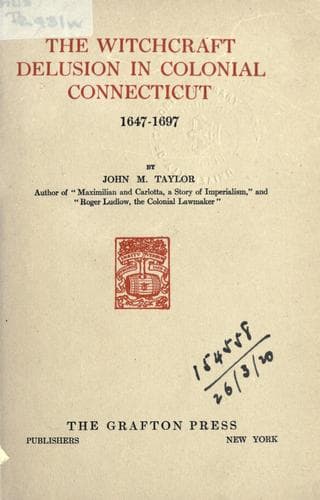
The Witchcraft Delusion in Colonial Connecticut (1647-1697)Taylor, John M. (John Metcalf)
History
The Witchcraft Delusion in Colonial Connecticut (1647-1697)
Taylor, John M. (John Metcalf)
Connecticut -- History -- Colonial period, ca. 1600-1775; Witchcraft -- Connecticut -- History
Goody Edwards testified: "Y't as Goody Garlick owned, she sent to her
daughter for a little best milk and she had some and presently after,
her daughters milk went away as she thought and as she remembers the
child sickened about y't time." Goody Hand deposed that "she had heard
Goody Davis say that she hoped Goody Garlick would not come to
Eastharapton, because, she said, Goody Garlick was naughty, and there
had many sad things befallen y'm at the Island, as about ye child, and
ye ox, as Goody Birdsall have declared, as also the negro child she said
was taken away, as I understood by her words, in a strange manner, and
also of a ram y't was dead, and this fell out quickly one after another,
and also of a sow y't was fat and lustie and died. She said they did
burn some of the sow's tale and presently Goody Garlick did come in."
The settlers held a town meeting, and wisely questioning whether they
had legal authority to hold a trial in a capital case, they appointed a
committee to go "unto Keniticut to carry up Goodwife Garlick yt she may
be delivered up unto the authoritie there for the trial of the cause of
witchcraft which she is suspected for." The General Court of Connecticut
took jurisdiction of the case, a trial of Goody Garlick was held,
resulting in her acquittal, and she was sent back to Easthampton, to
what end is not told in the records of the day.
CHAPTER X
"This case is one of the most painful in the entire Connecticut list,
for she impresses one as the best woman; how the just and high minded
old lady had excited hate or suspicion, we cannot know." _Connecticut as
a Colony_ (1: 212), MORGAN.
"Mr. Dauenport gaue in as followeth--That Mr. Ludlow sitting with him
and his wife alone, and discoursing of the passages concerning Knapps
wife, the Witch and her execution, said that she came downe from the
ladder (as he understood it), and desired to speak with him alone, and
told him who was the witch spoken of." _New Haven Colonial Record_
(2: 78).
"Shortly after this, a poor simple minded woman living in Fairfield, by
the name of Knap, was suspected of witchcraft. She was tried, condemned
and sentenced to be hanged." SCHENCK'S _History of Fairfield_ (1: 71).
"GOODWIFE KNAP"
Public-domain text, read in full here on John Shaqi.
Reviews
Reviews
No reviews yet
Be the first to share your thoughts on this work.
Elsewhere in the archive
Join the Discussion
Join the discussion
Sign in to leave a comment or review.
Sign InorCreate an account