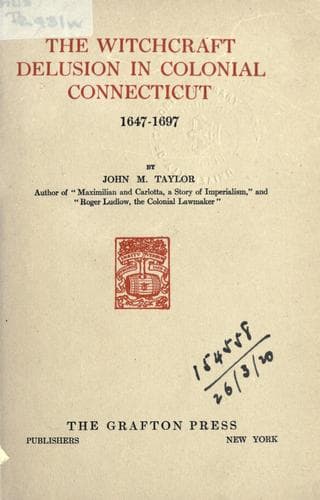
The Witchcraft Delusion in Colonial Connecticut (1647-1697)Taylor, John M. (John Metcalf)
History
The Witchcraft Delusion in Colonial Connecticut (1647-1697)
Taylor, John M. (John Metcalf)
Connecticut -- History -- Colonial period, ca. 1600-1775; Witchcraft -- Connecticut -- History
This was one of the most notable of the witchcraft cases. It stands
among the early instances of the infliction of the death penalty in
Connecticut; the victim was presumably a woman of good repute, and not a
common scold, an outcast, or a harridan; it is singularly illustrative
of witchcraft's activities and their grasp on the lives of the best men
and women, of the beliefs that ruled the community, and of the crude and
revolting practices resorted to in the punishments of the condemned, and
especially since in its later developments it involved in controversy
and litigation two of the great characters in colonial history, Rev.
John Davenport, one of the founders of New Haven, and Roger Ludlow,
Deputy Governor of Massachusetts and Connecticut.[I] Goodwife Knapp of
Fairfield was "suspicioned." That was enough to set the villagers agog
with talk and gossip and scandal about the unfortunate woman, which
poisoned the wells of sober thought and charitable purpose, and swiftly
ripened into a formal accusation and indictment.
[Footnote I: Connecticut, through its Commission of Sculpture, in
recognition of his services to the Colony, is to erect a memorial statue
to Ludlow to occupy the western niche on the northern facade of the
Capitol building at Hartford.]
Pending her trial the prisoner was committed to the house of correction
or common jail for the safe keeping of "refractory persons" and
criminals.
What terrors of mind and spirit must have waited on this "simple minded"
woman, in the cold, gloomy, and comfortless prison, probably built of
rough logs, with a single barred window and massive iron studded door, a
ghost haunted torture chamber, in charge of some harsh wardsmen.
Knapp was duly and truly tried, and sentenced to death by hanging, the
usual mode of execution. _No witch was ever burned in New England._
From the day sentence was pronounced until the hanging took place, out
in Try's field beyond the Indian field, in view of the villagers, whose
curiosity or thirst for horrors or whose duty led them there, this
prisoner of delusion was made the object of rudest treatment, espionage,
and of inhuman attempts to wring from her lips a confession of her own
guilt or an accusation against some other person as a witch.
The very day of her condemnation, a self-constituted committee of
women, with one man on it,--Mistress Thomas Sherwood, Goodwife Odell,
Mistress Pell, and her two daughters, Goody Lockwood, and Goodwife
Purdy,--visited the prison, and pressed her to name any other witch in
town, and so receive such consolation from the minister as would be for
her soul's welfare.
Public-domain text, read in full here on John Shaqi.
Reviews
Reviews
No reviews yet
Be the first to share your thoughts on this work.
Elsewhere in the archive
Join the Discussion
Join the discussion
Sign in to leave a comment or review.
Sign InorCreate an account