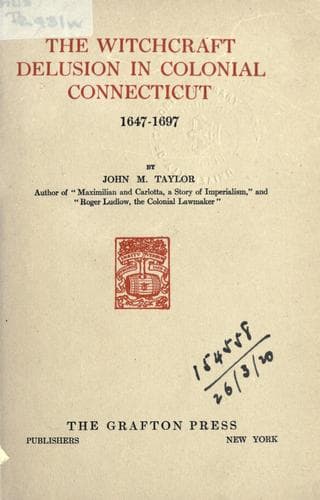
The Witchcraft Delusion in Colonial Connecticut (1647-1697)Taylor, John M. (John Metcalf)
History
The Witchcraft Delusion in Colonial Connecticut (1647-1697)
Taylor, John M. (John Metcalf)
Connecticut -- History -- Colonial period, ca. 1600-1775; Witchcraft -- Connecticut -- History
Mistress Pell seems to have been the chief spokeswoman, and each member
of the committee served in some degree as an inquisitor, or exhorter,
not to repentance, but to disclosures. Baited and badgered, warned and
threatened, the hapless prisoner protested she was innocent, denied the
charges made against her, told one of the committee to "take heed the
devile have not you," and also said, "I must not render evil for
evil.... I have sins enough allready, and I will not add this [accusing
another] to my condemnation." And at last in agony of soul she made that
pathetic appeal to one of her relentless tormentors, "neuer, neuer poore
creature was tempted as I am tempted, pray, pray for me."
But even after death on the scaffold, the witch-hunters of the day did
not refrain from their ghoulish work, but desecrated the remains of
Goodwife Knapp at the grave side in their search for witch marks.
All the facts during the imprisonment, execution and burial are set
forth in some of the testimonies herewith given, in a chapter of related
history (the evidence at the trial not being disclosed in any present
record), and all of them marked by a total unconsciousness of their
sinister and revolting character.
No case in the history of the delusion in New England is more replete
in incidents and apt illustrations, due to their fortunate preservation
in the records of a lawsuit involving some of the prominent characters
in that drama of religious insanity.
At a magistrate's court held at New Haven the 29th of May, 1654.
Present.
Theophilus Eaton Esqr, Gouernor.
Mr. Stephen Goodyeare, Dept, Gouernor.
Francis Newman \
Mr. William Fowler } Magistrats
Mr. William Leete /
a suit was heard entitled--
Thomas Staplies of Fairfield, plant'.
Mr Rogger Ludlow late of Fairfield, defendt.
It was brought by an aggrieved husband to recover damages for defamation
of the character of his wife. It centered in one of the dramatic
incidents at Knapp's execution. In the last extremity, and in the
presence of immediate death, the prisoner came down from the ladder, and
asking to speak with Ludlow alone, told him that Goodwife Staplies was a
witch.
Some time afterward Ludlow, at New Haven, told the Rev. John Davenport
and his wife the story, in confidence, and under the promise of secrecy,
but it spread abroad with inevitable accretions, and when it reached
Fairfield Thomas Staplies went to law, to vindicate his wife's character
in pounds, shillings, and pence. These are some of the statements and
remarkable testimonies:
Public-domain text, read in full here on John Shaqi.
Reviews
Reviews
No reviews yet
Be the first to share your thoughts on this work.
Elsewhere in the archive
Join the Discussion
Join the discussion
Sign in to leave a comment or review.
Sign InorCreate an account