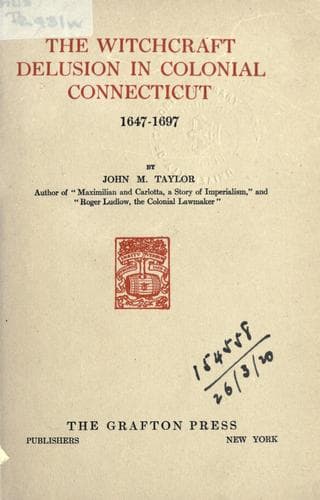
The Witchcraft Delusion in Colonial Connecticut (1647-1697)Taylor, John M. (John Metcalf)
History
The Witchcraft Delusion in Colonial Connecticut (1647-1697)
Taylor, John M. (John Metcalf)
Connecticut -- History -- Colonial period, ca. 1600-1775; Witchcraft -- Connecticut -- History
Is the contrast in human experience, between the servitude to credulity
and superstition in 1647-97 and the deliverance from it of this day, any
wider than between the ironclad theology of that and of later times, and
the challenge to it, and its diabolical logic, of yesterday, which marks
a new era in denominational creeds, in religious beliefs, and their
expression?
Jonathan Edwards, in his famous sermon at Enfield in 1741, on "Sinners
in the hands of an Angry God," was inspired to say to the impenitent:
"The God that holds you over the pit of hell, much as one holds a spider
or some loathsome insect over the fire, abhors you and is dreadfully
provoked; His wrath toward you burns like fire; He looks upon you as
worthy of nothing else but to be cast into the fire; He is of purer eyes
than to bear to have you in His sight; you are 10,000 times so
abominable in His eyes as the most hateful and venomous serpent is in
ours.... Instead of one how many is it likely will remember this
discourse in hell! And it would be a wonder if some that are now present
should not be in hell in a very short time--before this year is out. And
it would be no wonder if some persons, that now sit here in some seats
of this meeting-house, in health and quiet, and secure, should be there
before to-morrow morning." One hundred and sixty-three years later,
Rev. Dr. Samuel T. Carter, a godly minister of the same faith, "a
heretic who is no heretic," stood before the presbytery of Nassau, was
invited to remain in the Presbyterian communion, and yet said this of
the doctrine of Edwards, as written in the _Westminster Confession_: "In
God's name and Christ's name it is not true. There is no such God as the
God of the confession. There is no such world as the world of the
confession. There is no such eternity as the eternity of the
confession.... This world so full of flowers and sunshine and the
laughter of children is not a cursed lost world, and the 'endless
torment' of the confession is not God's, nor Christ's, nor the Bible's
idea of future punishment."
What should constitute the true faith of a Christian, and set him apart
from his fellowmen in duties and observances, was one of the crucial
questions in the everyday life of the early New England colonists, and
the hanging and discipline of witches was one of its necessary
incidents.
It was the same spirit of intolerance and of religious animosity that
was written in the treatment of the Quakers and Baptists at Boston; in
the experience of Roger Williams and Anne Hutchinson; and of "The
Rogerenes" in Connecticut, for "profanation of the Sabbath," told in a
chapter of forgotten history.
Public-domain text, read in full here on John Shaqi.
Reviews
Reviews
No reviews yet
Be the first to share your thoughts on this work.
Elsewhere in the archive
Join the Discussion
Join the discussion
Sign in to leave a comment or review.
Sign InorCreate an account