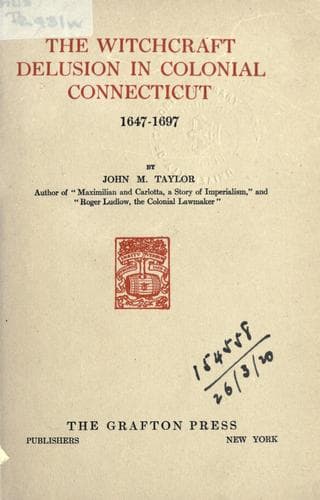
The Witchcraft Delusion in Colonial Connecticut (1647-1697)Taylor, John M. (John Metcalf)
History
The Witchcraft Delusion in Colonial Connecticut (1647-1697)
Taylor, John M. (John Metcalf)
Connecticut -- History -- Colonial period, ca. 1600-1775; Witchcraft -- Connecticut -- History
In the sunlight of the later revelation, is not the present judgment of
the men and women of those far off times, "when the wheel of prayer was
in perpetual motion," when fear and superstition and the wrath of an
angry God ruled the strongest minds, truly interpreted in the solemn
afterthoughts which the poet ascribes to the magistrate and minister at
the grave of Giles Corey?
HATHORNE
"This is the Potter's Field. Behold the fate
Of those who deal in witchcrafts, and when questioned,
Refuse to plead their guilt or innocence,
And stubbornly drag death upon themselves.
MATHER
"Those who lie buried in the Potter's Field
Will rise again as surely as ourselves
That sleep in honored graves with epitaphs;
And this poor man whom we have made a victim,
Hereafter will be counted as a martyr."
_The New England Tragedies._
HISTORICAL NOTE
ROGER LUDLOW
The Connecticut historians to a very recent date, in ignorance of the
facts, and despite his notable services of twenty-four years to the
colonies, left Ludlow to die in obscurity in Virginia or elsewhere, and
some of the traditions, based on no record or other evidence, have been
recently repeated. It is therefore proper to state here in few words who
Ludlow was, what he did both in Massachusetts and Connecticut, and after
his "return into England" in 1654.
Ludlow came of an ancient English family, which gave to history in his
own time and generation such illustrious kinsmen as Sir Henry Ludlow, a
member of the Long Parliament and one of the Puritan leaders, and Sir
Edmund Ludlow, member of Parliament, Lieutenant-General under Cromwell,
member of the court at King Charles' trial, and whom Macaulay named "the
most illustrious saviour of a mighty race of men, the judges of a king,
the founders of a republic."
In May, 1630, Ludlow came to Massachusetts, as one of the Assistants
under the charter of "The Governor and company of Massachusetts Bay in
New England."
His services in the Bay Colony from 1630-35 ranged from the duties of a
magistrate in the Great Charter Court to those of the high office of
Deputy Governor. The quality of that service is written in a bare
statement of his various offices--surveyor, negotiator of the Pequot
treaty, colonel ex officio, auditor of Governor Winthrop's accounts,
superintendent of fortifications, military commissioner, member of the
General Court, Deputy Governor when Thomas Dudley was Governor; and he
was always one of the foremost men in civil, political, and social
affairs, to the day of his departure to "the valley of the long
river,"--a day of good fortune for Connecticut.
Public-domain text, read in full here on John Shaqi.
Reviews
Reviews
No reviews yet
Be the first to share your thoughts on this work.
Elsewhere in the archive
Join the Discussion
Join the discussion
Sign in to leave a comment or review.
Sign InorCreate an account