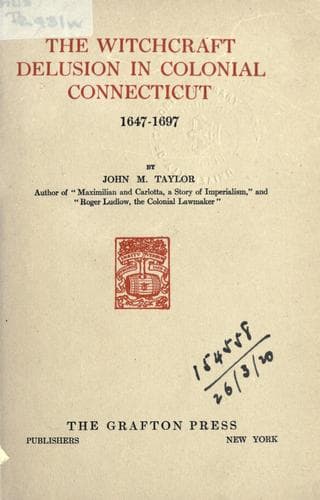
The Witchcraft Delusion in Colonial Connecticut (1647-1697)Taylor, John M. (John Metcalf)
History
The Witchcraft Delusion in Colonial Connecticut (1647-1697)
Taylor, John M. (John Metcalf)
Connecticut -- History -- Colonial period, ca. 1600-1775; Witchcraft -- Connecticut -- History
When Massachusetts established church membership as the condition of
suffrage,--and radical differences of opinion on other matters
arose,--it marked the culmination of a set purpose of some of her ablest
men to remove from her jurisdiction, among whom Hooker, Ludlow, and
Haynes were the most notable. The General Court created a commission to
govern Connecticut for a year, and made Ludlow its chief. He came to the
new land of promise with the Dorchester men, and settled in Windsor in
1635-36.
What he did in the nineteen years of his residence at Windsor and
Fairfield is epitomized in a brief summary of the duties and honors to
which he was called by his fellowmen:
Chief of the Massachusetts commission and the first Governor, de facto;
organizer and chief magistrate of the first court; writer of the
earliest laws; president of the court which declared war against the
Pequots; framer of the Fundamental Orders--the Constitution of
1639--which embodied the great principles of government by the people
propounded and elucidated by the illustrious Thomas Hooker, in his
letter to Governor Winthrop, and in his famous sermon; compiler, at the
request of the General Court, of the _Body of Lawes_, the _Code of
1650_; commissioner on important state matters; commissioner for the
United Colonies; founder and defender of Fairfield; patriot, jurist,
statesman.
Ludlow left Connecticut in 1654, not to die in obscurity as the earlier
writers imagined, but to serve abroad for several years in positions of
honor and distinction.
Cromwell invited him to return, as he did many of the leading Puritans
in New England, and appointed him a commissioner for the administration
of justice in Dublin; also to serve with the chief justice of the upper
bench and other distinguished lawyers, to determine all the claims to
the forfeited Irish lands, and at last as a Master in Chancery.
Ten years Ludlow served in these important stations; and at his death,
probably in 1664, he was buried in St. Michael's churchyard in Dublin,
with his wife--a sister of Governor John Endicott--and other members of
his family.[K]
[Footnote K: _Roger Ludlow--The Colonial Lawmaker_--TAYLOR.]
BIBLIOGRAPHICAL NOTE
Some of the authorities and records in witchcraft literature consulted
in the writing of this essay are here cited for reference and
information:
Public-domain text, read in full here on John Shaqi.
Reviews
Reviews
No reviews yet
Be the first to share your thoughts on this work.
Elsewhere in the archive
Join the Discussion
Join the discussion
Sign in to leave a comment or review.
Sign InorCreate an account