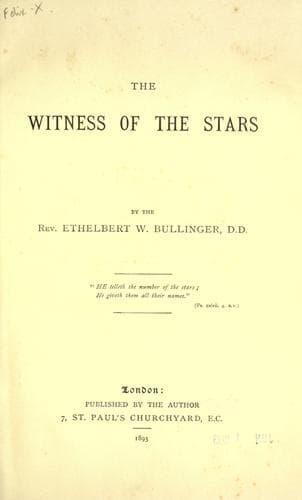
The Witness of the StarsBullinger, E. W. (Ethelbert William)
Religion
The Witness of the Stars
Bullinger, E. W. (Ethelbert William)
Astronomy; Astronomy in the Bible; Bible and science; Constellations
portion, for God has “prepared for them a city,” and we see that prepared
city, even “the holy city, new Jerusalem, coming down from God out of
HEAVEN, prepared as a bride adorned for her husband” (Rev. xxi. 2). This
is the “heavenly” portion of the Old Testament saints, the Bride of
Christ. The Church will have a still “better” portion, for “they without
us should not be made perfect” (Heb. xi. 40).
The fish, shooting upwards to the Polar Star, exquisitely pictures this
“heavenly calling”; while the other fish, keeping on the horizontal line,
answers to those who were content with an earthly portion.
But both alike were divinely called, and chosen, and upheld. The names of
two of the stars in the sign (not identified) are _Okda_ (Hebrew), _the
united_, and _Al Samaca_ (Arabic), _the upheld_.(53) These again speak of
the redeemed seed, of whom, and to whom, Jehovah speaks in that coming day
of glory in Isa. xli. 8‐10 (R.V.):—
“But thou, Israel, My servant,
Jacob, whom I have chosen,
The seed of Abraham My friend;
Thou whom I have taken hold of from the ends of the earth,
And called thee from the corners thereof,
And said unto thee, Thou art My servant;
I have chosen thee, and not cast thee away;
Fear thou not, for I am with thee;
Be not dismayed, for I am thy God!
I will strengthen thee;
Yea, I will help thee;
Yea, I will UPHOLD thee with the right hand of My righteousness.”
This is the teaching of the Sign; and the first constellation takes up
this thought and emphasises it.
1. THE BAND.
_The Redeemed Bound, but binding their Enemy._
The band that _unites_ these two fishes has always formed a separate
constellation. It is shown in Plate XXI. The Arabian poems of ANTARAH
frequently mention it as distinct from the Sign with which it is so
closely connected. ANTARAH was an Arabian poet of the sixth century.
Its ancient Egyptian name was _U‐or_, which means _He cometh_. Its Arabic
name is _Al Risha_, _the band_, or _bridle_.
It speaks of the Coming One, not in His relation to Himself, or to His
enemies, but in His relation to _the Redeemed_. It speaks of Him who says:
“I drew them with cords of a man,
With bands of love;
And I was to them as they that take off the yoke on their jaws.”
(Hosea xi. 4, R.V.)
But it speaks also of His unloosing the bands with which they have been so
long bound.
Public-domain text, read in full here on John Shaqi.
Reviews
Reviews
No reviews yet
Be the first to share your thoughts on this work.
Join the Discussion
Join the discussion
Sign in to leave a comment or review.
Sign InorCreate an account