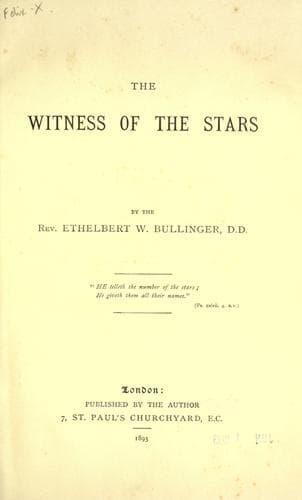
The Witness of the StarsBullinger, E. W. (Ethelbert William)
Religion
The Witness of the Stars
Bullinger, E. W. (Ethelbert William)
Astronomy; Astronomy in the Bible; Bible and science; Constellations
Most commentators agree that the constellation of “Draco,” or the Dragon
(between the Great and Little Bear), is referred to in Job xxvi. 13: “By
His Spirit He hath garnished the heavens; His hand hath formed the crooked
serpent (R.V. swift. Marg. _fleeing_ or _gliding_. See Is. xxvii. 1;
xliii. 14).” This word “garnished” is peculiar. The R.V. puts in the
margin, _beauty_. In Ps. xvi. 6, it is rendered _goodly_. “I have a goodly
heritage.” In Dan. iv. 2, it is rendered, “I thought it good to show,”
referring to “the signs and wonders” with which God had visited
Nebuchadnezzar. It appears from this that God “_thought it good to show_”
by these signs written in the heavens the wonders of His purposes and
counsels, and it was by His Spirit that He made it known; it was His hand
that _coiled_ (חוּל) the crooked serpent among the stars of heaven.
Thus we see that the Scriptures are not silent as to the great antiquity
of the signs and constellations.
If we turn to history and tradition, we are at once met with the fact that
the Twelve Signs are the same, both as to the meaning of their names and
as to their order _in all the ancient nations of the world_. The Chinese,
Chaldean, and Egyptian records go back to more than 2,000 years B.C.
Indeed, the Zodiacs in the Temples of Denderah and Esnéh, in Egypt, are
doubtless copies of Zodiacs still more ancient, which, from internal
evidence, must be placed nearly 4,000 B.C., when the summer solstice was
in Leo.
Josephus hands down to us what he gives as the traditions of his own
nation, corroborated by his reference to eight ancient Gentile
authorities, whose works are lost. He says that they all assert that “God
gave the antediluvians such long life that they might perfect those things
which they had invented in astronomy.” Cassini commences his _History of
Astronomy_ by saying “It is impossible to doubt that astronomy was
invented from the beginning of the world; history, profane as well as
sacred, testifies to this truth.” Nouet, a French astronomer, infers that
the Egyptian Astronomy must have arisen 5,400 B.C.!
Ancient Persian and Arabian traditions ascribe its invention to Adam,
Seth, and Enoch. Josephus asserts that it originated in the family of
Seth; and he says that the children of Seth, and especially Adam, Seth,
and Enoch, that their revelation might not be lost as to the two coming
judgments of Water and Fire, made two pillars (one of brick, the other of
stone), describing the whole of the predictions of the stars upon them,
and in case the brick pillar should be destroyed by the flood, the stone
would preserve the revelation (Book i. chs. 1‐3).
Public-domain text, read in full here on John Shaqi.
Reviews
Reviews
No reviews yet
Be the first to share your thoughts on this work.
Join the Discussion
Join the discussion
Sign in to leave a comment or review.
Sign InorCreate an account