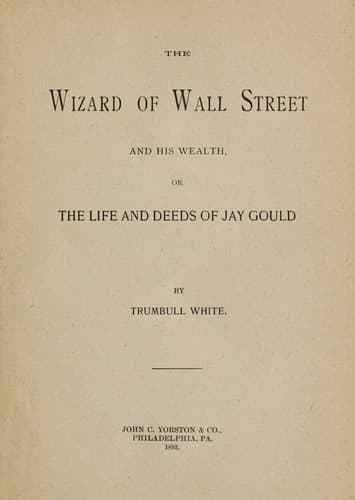
The Wizard of Wall Street and His Wealth; or, The Life and Deeds of Jay GouldWhite, Trumbull
History
The Wizard of Wall Street and His Wealth; or, The Life and Deeds of Jay Gould
White, Trumbull
Businessmen -- United States -- Biography; Capitalists and financiers -- United States -- Biography; Gould, Jay, 1836-1892
Edwin Gould, the second son, has a shorter list of offices. He is
president of the St. Louis Southwestern, a director in Western Union
and a member of the executive committee, and a director in the
Manhattan and Missouri Pacific railroad companies. He has done some
very successful work in finance, and has been counted a very shrewd
operator from the beginning of his business career. The story is told
of him that when he was starting out in money-making his father
decided to test his mettle, and was highly delighted when the youth
came out of the conflict with flying colors. Edwin Gould is a member of
the Consolidated Exchange.
Howard Gould, the third son, is getting his first experience in
business. He has been given as a start a seat in the directorate of the
International and Great Northern Railroad Company.
Considerable interest attaches to the liability of the Gould estate for
the payment of an inheritance tax. While the terms of the will are of
course not known, and the question of public bequests is not settled,
the Wall street idea is that such bequests, if they exist, are not
likely to cut into the total to any appreciable extent. Under the laws
of 1892 property bequeathed to Mr. Gould’s children will be liable to a
tax of 1 per cent. Section 2 of chapter 399 says:
“When the property or any beneficial interest therein passes,
by any such transfer, to or for the use of any father, mother,
husband, wife, child, brother, sister, wife or widow of a son, or
the husband of a daughter, or any child or children adopted as such
in conformity with the laws of this state, or to any person to whom
any such decedent, grantor, donor, or vendor for not less than ten
years prior to such transfer stood in the mutually-acknowledged
relation of a parent, or to any lineal descendant of such decedent
grantor, donor, or vendor born in lawful wedlock, such transfer
shall not be taxable under this act unless it is personal property
to the value of $10,000 or more, in which case it shall be taxable
under this act at the rate of 1 per centum upon the clear market
value of such property.”
The next section makes the tax a lien upon the property until it is
paid. The tax is to be collected by the controller of the county.
Payment within six months gives a discount of 5 per cent.; if it is
not made in eighteen months a penalty of 10 per cent. is provided. The
controller’s fee is 5 per cent. on the first $50,000 of the tax, 3 per
cent. on the second $50,000, and 1 per cent. on the rest. The balance
of the tax is to be paid into the State Treasury.
A tax of 1 per cent. on the estate should yield from $650,000 to
$1,000,000, according to which of the limits on the estimate approaches
the real valuation. The controller accordingly would figure on a fee of
from $8,000 to $13,000.
Public-domain text, read in full here on John Shaqi.
Reviews
Reviews
No reviews yet
Be the first to share your thoughts on this work.
Elsewhere in the archive
Join the Discussion
Join the discussion
Sign in to leave a comment or review.
Sign InorCreate an account