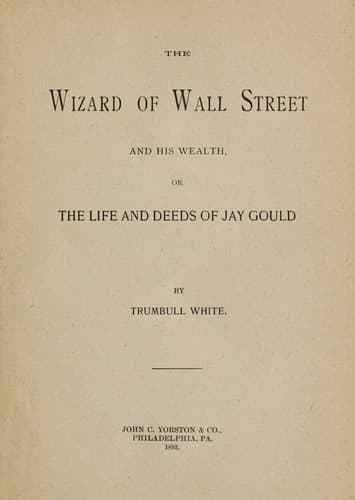
The Wizard of Wall Street and His Wealth; or, The Life and Deeds of Jay GouldWhite, Trumbull
History
The Wizard of Wall Street and His Wealth; or, The Life and Deeds of Jay Gould
White, Trumbull
Businessmen -- United States -- Biography; Capitalists and financiers -- United States -- Biography; Gould, Jay, 1836-1892
It was said at the corporation counsel’s office that if it shall be
proved that Mr. Gould has left his personal property, especially his
railroad interests, in hands of trustees for a term of years, the
interest to go to his children, the fact that the estate is in the
hands of trustees cannot prevent the state from levying and collecting
the inheritance tax.
Said one of the assistant corporation counsels: “If Mr. Gould could
by the terms of his will, by deed or gift or otherwise, make such a
disposition of his estate as to render the law in such cases nugatory,
his children and heirs to the remotest generation, when they came to
devise their property, could do the same thing, and the estate would
thus be perpetually barred of its rights. I believe that the personal
estate that Mr. Gould has left for the benefit of his children, no
matter in what form, is taxable at 1 per cent. All property left out
of lineal descent would be taxed at 5 per cent. on its clear market
value.”
In spite of Jay Gould’s many millions, he was down on the tax-lists for
very modest amounts. He seems to have had as much ability in keeping
down his taxes as in piling up his millions. Despite his immense
accumulations, he paid taxes on only $500,000 in personal property. The
real estate on which he paid directly was confined to the Grand Opera
House, of which he was the owner, and to his home on Fifth avenue. At
one time he also paid the taxes on his son’s home on East Forty-seventh
street, but after that formally passed out of his possession he was, of
course, relieved from paying any further taxes on that property.
Notwithstanding the very conservative estimate placed upon the value
of his personal holdings, Mr. Gould tried, a few years ago, to escape
paying any personal taxes at all in this city. He urged the familiar
plea of outside residence, and because he paid personal taxes in
Westchester county on his belongings at his country home at Irvington,
insisted that he was being unfairly treated in being compelled to pay
even on that supposititious $500,000 of personal property in this
city. He did not press the matter, however, and continued to allow his
personal property to be placed on the tax-list at $500,000.
Commissioner Baker, of the tax department, said that it was impossible
to tell just what Mr. Gould’s holdings in real estate in New York
really amounted to.
“Real estate,” Mr. Baker explained, “is entered on the books of the
tax department by number only. The only way to get any idea there as
to the ownership of a piece of property is to see who paid the taxes
on it. According to this test, the real estate on which Mr. Gould paid
taxes in New York is confined to his residence. The Manhattan Railroad
Company is a large holder of real estate, but the company pays its own
taxes, of course, and the only place Mr. Gould’s name appears on the
tax department books is in relation to his residence and the admitted
$500,000 of personal property.”
Public-domain text, read in full here on John Shaqi.
Reviews
Reviews
No reviews yet
Be the first to share your thoughts on this work.
Elsewhere in the archive
Join the Discussion
Join the discussion
Sign in to leave a comment or review.
Sign InorCreate an account