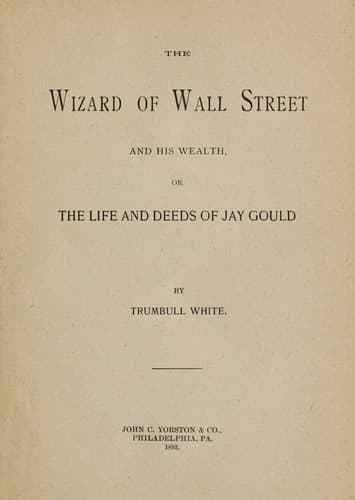
The Wizard of Wall Street and His Wealth; or, The Life and Deeds of Jay GouldWhite, Trumbull
History
The Wizard of Wall Street and His Wealth; or, The Life and Deeds of Jay Gould
White, Trumbull
Businessmen -- United States -- Biography; Capitalists and financiers -- United States -- Biography; Gould, Jay, 1836-1892
Ex-Tax Commissioner Coleman added the opera house property to the list
that Mr. Gould paid on personally.
“The peculiarity of the matter,” said Mr. Coleman, “is that Gould was
never really in business in New York City. His wealth was very largely
in stocks that had no particular value by themselves and that were not
even on the market. He made his money by taking hold of almost bankrupt
companies, getting control of the common stock that had no particular
value beyond its voting power, and then by manipulating things to his
own interest.
“Besides, his various railroad stocks, like the Union Pacific, Wabash,
Texas and Kansas Pacific, were not assessable. The bonds that were
assessable were generally those of roads that had been reorganized
and reorganized till any estimate of value became a pure matter of
guesswork. Then he could come in and swear down the valuations.”
The tax commissioners are compelled to take any man’s affidavit as to
the value of his personal property, and, as Commissioner Baker put
it, “Where it’s a question of dollars and cents, we find every man’s
conscience becomes rather pliable.”
Mr. Gould seems not to have cared to pass as an exception to so
well-established a rule, and hence the modest estimate he placed on his
earthly possessions for the purposes of the tax collector. As a result
of this trustful feature of the assessment laws, $25,000 a year is said
to be an ample estimate for the entire amount of annual taxes Mr. Gould
paid on his variously estimated millions.
CHAPTER XIX.
JAY GOULD’S RELATIONS WITH THE PUBLIC.
There are interesting features of the life of Jay Gould regarding his
relations with the public, the church, the press and the people whom he
met.
Jay Gould was not what is called a religious man. He was a pewholder
in the Presbyterian church at Irvington and in the Rev. Dr. Paxton’s
church on West Forty-second street, but not a communicant. If he
ever expressed any religious views it was to the Rev. Dr. Paxton.
Certainly he did not to the Rev. Dr. Henry M. MacCracken, chancellor
of the University, nor to the Rev. Roderick Terry, with whom he was on
intimate terms of friendship. Dr. Terry said:
“There was no pretense about Mr. Gould. He never made any public
profession of Christianity that I know of. On the subject of religion,
as on so many others, he was extremely reticent, unless he unbosomed
himself to his pastor, Dr. Paxton. He certainly never talked with me
about his feelings on the subject of religion, though the opportunity
offered more than once.”
[Illustration: JAY GOULD’S PRIVATE CAR AND HIS YACHT “ATALANTA.”]
Public-domain text, read in full here on John Shaqi.
Reviews
Reviews
No reviews yet
Be the first to share your thoughts on this work.
Elsewhere in the archive
Join the Discussion
Join the discussion
Sign in to leave a comment or review.
Sign InorCreate an account