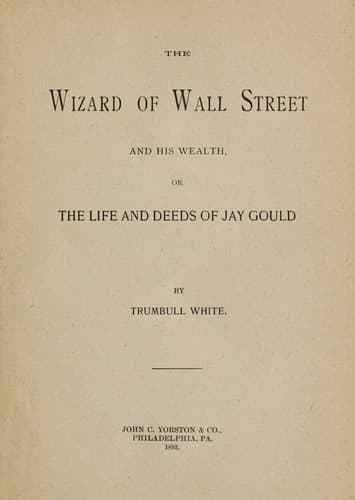
The Wizard of Wall Street and His Wealth; or, The Life and Deeds of Jay Gould — John Shaqi
The Wizard of Wall Street and His Wealth; or, The Life and Deeds of Jay GouldWhite, Trumbull
History
The Wizard of Wall Street and His Wealth; or, The Life and Deeds of Jay Gould
White, Trumbull
Businessmen -- United States -- Biography; Capitalists and financiers -- United States -- Biography; Gould, Jay, 1836-1892
It is a striking coincidence that young Gould and his two partners in
the map business were sued by the man who first employed the former
in the project, and they placed their case in the hands of Lawyer T.
R. Westbrook, who succeeded in having the suit dismissed. Westbrook
afterward became (and this is the coincidence) the supreme court judge,
who years after scandalized the legal profession by holding court in
Jay Gould’s private office and issuing an order in one of the Manhattan
railway litigations.
He and his cousin, with whom he entered into partnership at Albany,
increased the map business to the extent of sending surveyors into
various portions of Ohio, Pennsylvania and Michigan, but afterward the
contracts were transferred to a surveyor in Philadelphia.
From this time he was continuously employed as a surveyor, until
a severe attack of typhoid fever compelled him to give up outdoor
exposure. He had determined to make a complete survey of the entire
state of New York, and he did complete maps of Albany county, the
village of Cohoes, the Albany and Niscayuna Plank road and Delaware
county. He also surveyed Lake and Geauga counties in Ohio, Oakland
county in Michigan, and a proposed railroad from Newburg to Syracuse.
Then he was seriously ill for several months, but his money was not
used up, and he wrote with some degree of interest and also profit a
history of Delaware county and partial histories of Greene, Ulster and
Sullivan counties.
Gould had gathered his ideas of casual writing from a brief experience
in a country newspaper office, where he had worked gratuitously.
The history of Delaware county was four hundred pages long, and is
said to have been an exceedingly creditable performance, both as an
example of diligence and care in the collection of facts and skill
and taste in the literary presentation of them. It never came into
general circulation, however, probably because the printer, who lived
in Philadelphia, insisted, in spite of “copy” and proof corrections,
in spelling the name of the author “Gold.” When the books arrived in
Roxbury and the young historian discovered the blunder he shipped them
all back to the manufacturer and would have nothing more to do with
them.
Public-domain text, read in full here on John Shaqi.
Reviews
Reviews
No reviews yet
Be the first to share your thoughts on this work.
Join the Discussion
Join the discussion
Sign in to leave a comment or review.
Sign InorCreate an account