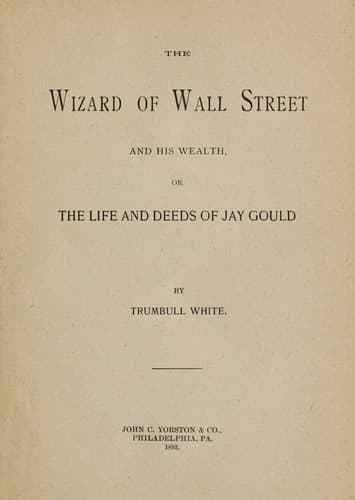
The Wizard of Wall Street and His Wealth; or, The Life and Deeds of Jay GouldWhite, Trumbull
History
The Wizard of Wall Street and His Wealth; or, The Life and Deeds of Jay Gould
White, Trumbull
Businessmen -- United States -- Biography; Capitalists and financiers -- United States -- Biography; Gould, Jay, 1836-1892
Did he ever, in those years of scheming and fighting for wealth, cast
his recollection backward to the old days at Roxbury, when he was but
a barefoot farmer’s boy, with nothing more oppressive on his mind than
the necessity to go through the rain for the cows, or to find the nest
that the blue hen had hidden away some place in the hay-mow?
There was little in the associations that he made during these first
Wall street years to remind him of those days. For while many of the
men with whom he came in contact had been like himself, the sons of
farmers with the first years of their lives spent far from the city,
yet from this time, all their “watering” of stock was entirely in the
direction of stocks which represented the value of railroads and other
properties, and all their knowledge of farm products was devoted to the
manipulation of grain markets.
As Gould’s acquaintance grew larger, and his success in ordinary small
ventures became assured, his disposition began to demand something of
greater magnitude, something with more satisfaction in it for that
appetite that was already becoming insatiable. A few small railroad
ventures were carried through in a manner bordering upon perfection,
and this increased the confidence in him of those speculators who
were already his acquaintances. The way opened for him to enter into
the manipulations of Erie, and, as before, when opportunity came he
recognized and grasped it.
CHAPTER VI.
GOULD’S ASSAULT UPON ERIE.
The most thrilling, the most discreditable portion of Gould’s career,
is contained in the ten years following the close of the war of the
rebellion. The blackest pages in the history of American railways
comprise the chapter relating to the Erie and the most shameful efforts
to wreck the fortunes of a thousand men for the aggrandizement of
the fortunes of a few, were made in connection with the schemes that
resulted in “Black Friday.”
Nothing in the Credit Mobilier and the history of the rise of the
Pacific railroads equals in downright violation of sacred trusts,
in absolute plunder of vast properties, and in wholesale bribery
and corruption, the record of Erie. Even Mr. Gould, in his sworn
autobiography in that celebrated investigation before the committee on
labor and education, while careful to give minute details about other
periods of his history, significantly preserved an entire silence as
to Erie and “Black Friday”--two incidents in his career which nothing
but an effort to conceal could explain his silence regarding. That
this is no exaggeration of language, an examination of the facts will
show. There is no intention to speak maliciously of Gould. Beside an
open grave, charity and forgetfulness stand guard on either side. But
the lesson of Gould’s career would be lost, if even at this time the
facts were not plainly and openly told. To say that Gould ruthlessly
plundered the Erie railway is to speak the plain truth.
Public-domain text, read in full here on John Shaqi.
Reviews
Reviews
No reviews yet
Be the first to share your thoughts on this work.
Join the Discussion
Join the discussion
Sign in to leave a comment or review.
Sign InorCreate an account