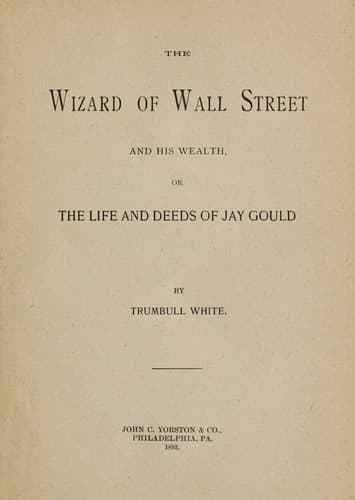
The Wizard of Wall Street and His Wealth; or, The Life and Deeds of Jay Gould — John Shaqi
The Wizard of Wall Street and His Wealth; or, The Life and Deeds of Jay GouldWhite, Trumbull
History
The Wizard of Wall Street and His Wealth; or, The Life and Deeds of Jay Gould
White, Trumbull
Businessmen -- United States -- Biography; Capitalists and financiers -- United States -- Biography; Gould, Jay, 1836-1892
It should be recorded at this time, however, that the famous
partnership of Gould and Fisk had been dissolved by death. Fisk, late
in 1871, had been shot by Edward F. Stokes, and after a few days had
died from the wound. He and Stokes had at one time been friends but had
quarreled over business matters and about a woman--the beautiful, but
notorious Josie Mansfield--and the quarrel led to the murder. It will
surprise no one who has read this history thus far that in the course
of the Erie litigations a Supreme Court judge once held court and
issued orders from Josie Mansfield’s apartments. Stokes was tried three
times. Once the jury disagreed. Once he was convicted of murder in
the first degree and sentenced to be hanged by Judge Noah Davis. This
verdict being overruled by the Court of Appeals, he was tried again
and convicted of manslaughter in the third degree. After serving a few
years in Auburn prison Mr. Stokes returned to New York, where he soon
became a prosperous business man, intimate for a long time with John A.
Mackay, the California millionaire, and president of a telegraph system
competing with Gould’s Western Union.
Before his death the belief is that Gould and Fisk had substantially
parted company. The New York _World_ of that day gives an account of
an interview between Gould and Fisk, in which the former asked Fisk
for his resignation as vice-president and comptroller of Erie. Fisk is
represented as saying to a friend who was about to leave for Europe:
“I would like you to do me a favor. If you find in Europe a mean man
who can do a meaner thing to his best friend or tell a bigger lie than
Jay Gould, I want you to telegraph me at once.” After Fisk’s death,
however, Gould acted handsomely by his widow. Whatever else may be said
of Fisk, he was certainly a more popular man than Gould, and after the
former’s death Gould did not long remain at the head of Erie. “The
feeling against Gould,” said Gen. Barlow, at the time of the anti-Gould
revolution, “grew in great part since Fisk’s death. Fisk was always
popular with the people of the road and in the office. Had he been
alive we should have had more trouble, or perhaps the move would never
have been made.”
Besides Barlow, Gen. Sickles had other efficient aid, and the
anti-Gould movement was strengthened by such names as Gen. John A. Dix,
who in the same year was elected governor of New York, Gen. George B.
McClellan and William R. Travers.
Public-domain text, read in full here on John Shaqi.
Reviews
Reviews
No reviews yet
Be the first to share your thoughts on this work.
Join the Discussion
Join the discussion
Sign in to leave a comment or review.
Sign InorCreate an account