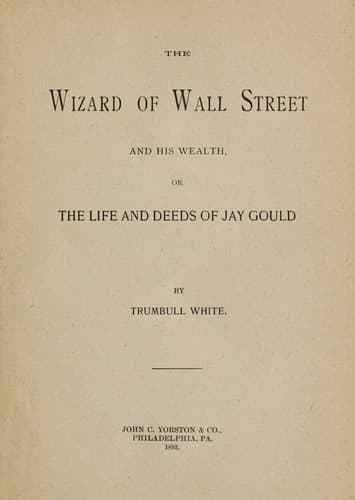
The Wizard of Wall Street and His Wealth; or, The Life and Deeds of Jay GouldWhite, Trumbull
History
The Wizard of Wall Street and His Wealth; or, The Life and Deeds of Jay Gould
White, Trumbull
Businessmen -- United States -- Biography; Capitalists and financiers -- United States -- Biography; Gould, Jay, 1836-1892
Finding that he was defeated, Gould then resorted to one of those
acts of audacity with which at different periods in his career he
has surprised the public. In a public letter he offered to leave all
the questions in dispute to arbitration by Horace Greeley. Thus he
attempted to place himself in favorable light before the public. But
it should not be supposed that Greeley was in any sense a friend of
Gould. On the contrary, the _Tribune_ of that day shows how severely he
criticised Gould.
The battle lasted one night and then Gould surrendered. He remained
as a director for a time, but his power was gone and Erie passed out
of his hands forever. The property has never fully recovered from the
condition into which it was thrown by the Drew-Gould regime. Though one
of the most important systems in the country and enjoying an immense
business, it is crippled with its enormous stock and bond liabilities,
and not until 1891 did it pay a dividend. For many years it remained
in the hands of a receiver.
The testimony of J. W. Guppy before the Hepburn Committee, already
referred to, gives some interesting details of Gould’s management of
the Erie. Among the roads which Erie leased were the Chemung railroad
and the Canandaigua and Elmira. These leases were very profitable
to Erie, but Gould, as an individual, after quietly purchasing a
majority of their capital stocks, as president of Erie refused to pay
the rentals, thus abrogating the leases. Then he sold the roads to
the Northern Central of Pennsylvania at a big profit. Gould and Fisk
organized a number of auxiliary companies whose plant was usually paid
for by Erie, but whose stock went into the pockets of Gould, Fisk and
their associates. Among these companies was the National Stock Yard
Company. The land was purchased and the improvements made by Erie,
but the stock was divided as so much spoils, 800 shares finding their
way into the pockets of Judge Barnard. The Erie Emigrant Company, the
Jefferson Railroad Company, the Blackford Company and the Greenwood
Coal Company were the names of some of the companies practically
saddled upon Erie, but whose stock was issued to Gould and Fisk without
consideration.
August Stein, who made an examination into the records, told the
Hepburn Committee that the amount of Gould’s wrong-doing in Erie was
about $12,000,000. By this was meant the amount which he wrongfully
appropriated.
Public-domain text, read in full here on John Shaqi.
Reviews
Reviews
No reviews yet
Be the first to share your thoughts on this work.
Join the Discussion
Join the discussion
Sign in to leave a comment or review.
Sign InorCreate an account