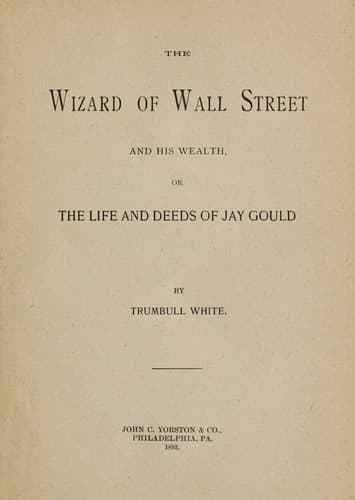
The Wizard of Wall Street and His Wealth; or, The Life and Deeds of Jay GouldWhite, Trumbull
History
The Wizard of Wall Street and His Wealth; or, The Life and Deeds of Jay Gould
White, Trumbull
Businessmen -- United States -- Biography; Capitalists and financiers -- United States -- Biography; Gould, Jay, 1836-1892
It was not in the Northwest corner that Smith was ruined, but in it he
lost a very large sum, which found its way into Gould’s pockets. Smith
was not slow in getting his revenge. The books of the late firm of
Smith, Gould & Martin were in his possession, and he handed them over
to Mr. Barlow, of the Erie, who quickly discovered in them the evidence
on which to obtain an order of arrest for Gould and to establish a
suit for the recovery of $12,803,059, the proceeds of bonds converted
into stock to the extent of 407,347 shares, which were sold by Mr.
Gould’s firm and the proceeds transferred to his pocket. That was the
charge, and Gould was arrested and placed under very heavy bonds, which
he furnished. Here Mr. Gould’s genius displayed itself. He actually
entered into a big speculation based on his restitution of this
plunder. Gen. Dix, it should be recorded, remained as president of Erie
for only a few months, and was succeeded by President Watson, a man who
owed his position mainly to Horace F. Clark, who, as has been seen, was
in intimate business relations with Gould. Clark undertook to arrange a
compromise between Watson and Gould, and all three evidently united to
“rig” the stock market by the operation. One day it was reported that
Gould intended to restore his plunder, and the price of Erie advanced
with a bound. A day or two later a denial of the report would come,
and down would go the price. This was repeated two or three times and
Gould, of course, bought at the low figures and sold at the top, and
the profits must have been big. Finally the restitution, so-called, was
announced with a flourish of trumpets. On the face of the agreement
Gould made over to Erie an immense amount of property and all suits
were withdrawn and Gould released from all criminal responsibility. A
clause in the agreement said that in making this transfer of property
Gould expressly stipulated that it should not be considered as an
admission of wrong-doing. The Opera House and adjoining buildings and
other real estate, with the exception of Gould’s Fifth avenue mansion,
were made over to the Erie, and, in addition, a mass of stocks of
the par value of about $6,000,000. As a matter of fact most of these
stocks were worthless. J. G. Guppy told the Hepburn Committee that he
would not give $200,000 for the entire lot. Among the securities were
$1,000,000 of United States Express stock to be issued, and which Gould
guaranteed to be issued, but which, as a matter of fact, never was.
When Hugh J. Jewett became receiver of Erie he discovered the utter
sham of this alleged restitution. He told the Hepburn Committee: “Mr.
Watson had made a settlement with Mr. Gould, in which he received in
liquidation of this account, or such portion of it as he supposed he
could recover, certain assets. When I came here I sought to realize on
these assets. I found many of them totally worthless, and some which
were of value were encumbered by existing liens.”
Public-domain text, read in full here on John Shaqi.
Reviews
Reviews
No reviews yet
Be the first to share your thoughts on this work.
Join the Discussion
Join the discussion
Sign in to leave a comment or review.
Sign InorCreate an account