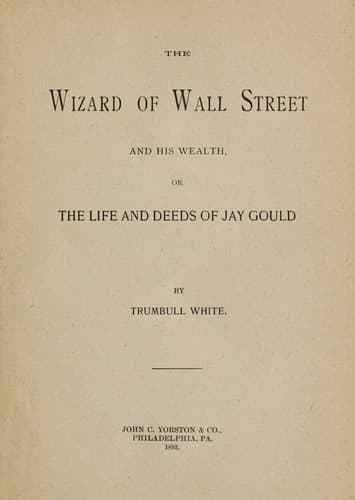
The Wizard of Wall Street and His Wealth; or, The Life and Deeds of Jay Gould — John Shaqi
The Wizard of Wall Street and His Wealth; or, The Life and Deeds of Jay GouldWhite, Trumbull
History
The Wizard of Wall Street and His Wealth; or, The Life and Deeds of Jay Gould
White, Trumbull
Businessmen -- United States -- Biography; Capitalists and financiers -- United States -- Biography; Gould, Jay, 1836-1892
“It was arranged that Gen. Grant should accompany a party one beautiful
evening in the middle of June, who were going to attend the great
Peace Jubilee of Patrick Sarsfield Gilmore in Boston. Jim Fisk did the
executive work in the arrangement. There was a fine champagne supper
on board the Boston boat and several gentlemen were present who were
thoroughly conversant with financial question’s and could talk glibly
on the state of the country. Mr. Gould said, in his testimony: ‘I took
the ground that the government ought to let go of the loan and let
it find its commercial level; that in fact it ought to facilitate an
upward movement in gold in the fall.’
“This reference to ‘its commercial level’ is rich, coming from the head
center of the plotters who wanted to put the article up to 200.
“About the time the above events were transpiring, the Assistant
Secretary of the Treasury, Mr. H. H. VanDyck, resigned his office in
this city. Mr. Gould’s chief ambition was to name his successor in
order that he might be able to control the treasury when the time to
get a corner in gold should be ripe. Mr. Abel R. Corbin came in quite
handy at this juncture to help to further the designs of Mr. Gould.
He was a man of fair education and considerable experience both in
business and politics. He had been a lobbyist in Washington for some
years. He was well informed on financial matters, a pretty good writer,
and could talk like a book. His wife was a sister of Mrs. Grant and
he had good opportunities for reaching the presidential ear, which he
employed to the best advantage.
“A gentleman named Robert B. Catherwood, who was married to a
step-daughter of Mr. Corbin, was approached by Gould and Corbin on the
subject of the Assistant Treasurership. They were anxious that Mr.
Catherwood should take the office and told him that he would make a
great deal of money in a perfectly legitimate manner if he were once
installed.
“So Mr. Catherwood stated in his testimony before the investigating
committee, but he adds: ‘My ideas differed from theirs in what
constituted a legitimate manner and I declined the office.’
“The office then sought another man in the person of Gen. Daniel
Butterfield. He received the intimation of his appointment in a very
different spirit from Mr. Catherwood, showing that he was fully equal
to the occasion. He wrote a letter to Mr. Corbin, thanking him kindly
for the offer, saying that he was under numerous obligations to him,
and expressing a hope that he would be eminently successful in his
undertaking. Gen. Butterfield received his commission in due course.
“Corbin talked with Grant until he received a positive assurance that
Boutwell was not to sell any more gold. At a meeting in Grant’s house,
where Gould and Corbin were present, the President said: ‘Boutwell gave
an order to sell gold, and I heard of it and countermanded the order.’
Public-domain text, read in full here on John Shaqi.
Reviews
Reviews
No reviews yet
Be the first to share your thoughts on this work.
Join the Discussion
Join the discussion
Sign in to leave a comment or review.
Sign InorCreate an account