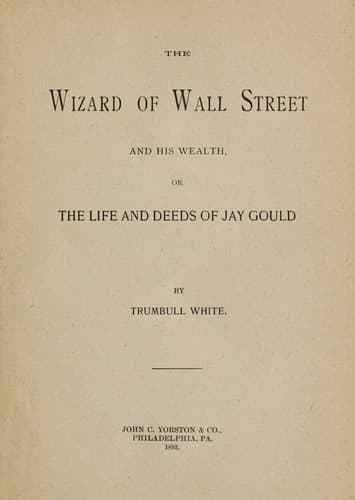
The Wizard of Wall Street and His Wealth; or, The Life and Deeds of Jay GouldWhite, Trumbull
History
The Wizard of Wall Street and His Wealth; or, The Life and Deeds of Jay Gould
White, Trumbull
Businessmen -- United States -- Biography; Capitalists and financiers -- United States -- Biography; Gould, Jay, 1836-1892
“The Union Pacific company has received $176,294,793.53 in surplus
earnings and land sales during eighteen years, and if its stock had
been fully paid, as Congress required that it should be and as its
officers certified under oath that it was, nearly all of that money
would be applicable to-day to the payment of the government debt. The
company has paid out $28,650,770 in dividends, and $82,742,850 in
interest on bonds, nearly all of which were distributed to shareholders
without consideration. It has sunk over $10,000,000 in Denver, South
Park and Pacific; it paid out $10,000,000 to Jay Gould and his
associates for branch lines and other investments which were worthless,
and which were unloaded upon the Union Pacific because of the
faithlessness of the management of the company. The gross mismanagement
of the Union Pacific and the other Pacific railroads has injured the
credit of foreign investors to such an extent that hundreds of millions
of dollars, which otherwise would have been sent here for investment
and aided in the development of the country, have been locked up
abroad.”
Every line of this indictment is directed at Gould. Yet Charles Francis
Adams, the author of “A Chapter in Erie,” and who became president of
the Union Pacific about the time Gould retired, told the commission
that he believed from careful scrutiny that Mr. Gould had always been
more than fair to the company. But the commission, with all the facts
before it, rejected his view of the case.
When Mr. Gould secured possession of the Union Pacific, Sidney Dillon
was president of it, and they with other large stockholders agreed upon
a plan to fund the floating debt in bonds, of which Mr. Gould took
$1,000,000. Mr. Gould remained in practical control of the property
until about 1880, when public opinion clamored for a change, and as
Mr. Gould said to one of the numerous investigating committees before
which he was called upon during his busy life to testify: “I bowed to
public opinion. I let outside parties in and soon, instead of thirty
or forty stockholders, there were 6,000 or 7,000.” Mr. Charles Francis
Adams succeeded Sidney Dillon as president, and in a short time an
astonished public beheld the spectacle of the author of the scathing
“Chapter of Erie” standing sponsor for the man he had denounced. Mr.
Gould managed to persuade Mr. Adams to view the future of Union Pacific
through his (Gould’s) eyes, and in consequence Mr. Adams unconsciously
assisted Mr. Gould in disposing of large blocks of the stock to good
advantage. In 1891 Mr. Gould again got control of the Union Pacific
road, owing to peculiar Wall street conditions, and he calmly turned
Mr. Adams out of the presidency and put Sidney Dillon back there.
Public-domain text, read in full here on John Shaqi.
Reviews
Reviews
No reviews yet
Be the first to share your thoughts on this work.
Elsewhere in the archive
Join the Discussion
Join the discussion
Sign in to leave a comment or review.
Sign InorCreate an account