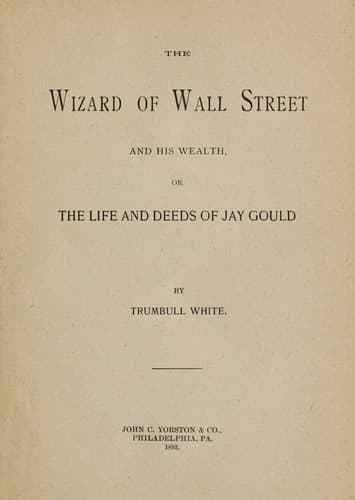
The Wizard of Wall Street and His Wealth; or, The Life and Deeds of Jay GouldWhite, Trumbull
History
The Wizard of Wall Street and His Wealth; or, The Life and Deeds of Jay Gould
White, Trumbull
Businessmen -- United States -- Biography; Capitalists and financiers -- United States -- Biography; Gould, Jay, 1836-1892
Mr. Gould’s railroad operations were entirely too numerous to be
followed in all their details, especially as enough has already been
given to indicate the character of his enterprises. But no life of
Mr. Gould would be complete without an account of his connection with
Wabash. On this road, however, he simply repeated, though to a less
degree, his tactics in Erie, and the result is a corporation almost
hopelessly burdened with enormous obligations.
In the _North American Review_ of February, 1888, will be found a
full history of this unfortunate road. The writer says that “Mr.
Gould remains the leading figure in the chapter of Wabash as he was
of Erie.” There is, he says, a “relative disappearance of the special
forms of judicial usurpation and misconduct which lent such a lurid
aspect to Mr. Adams’ story, and in their place will be noted one
sweeping judicial act followed by two or three supplementary acts which
accomplished the designs of the actors with complete effectiveness.”
Gould gained control of the road in 1879 and became president in 1881.
The writer of the _Review_ article sums up the history of Wabash as
follows:
“The Wabash system arose from the absorption and consolidation of
sixty-eight separate original corporations; when thus consolidated
the system owned and controlled in 1883 about 4,814 miles of railroad
in the six states of Ohio, Michigan, Indiana, Illinois, Missouri
and Iowa; its capital stock was increased between 1877 and 1883
from $40,000,000 to $50,174,700; its funded or mortgaged debt was
increased during the same period from $20,311,570.60 to $76,394,075;
three quarterly ‘dividends’ were paid on the entire preferred
stock in 1881--the year after the issue of the general mortgage in
1880--amounting to $1,036,529; within two years and a half after
these ‘dividends’ the company made default on the interest of all
its mortgaged debt; in May, 1884, the entire property was, on the
application of the debtor company alone, secretly placed in the hands
of Humphreys and Tutt, two of its former directors and officers,
men without any special qualifications for railroad management, and
who had been part of the directorate which had brought the system
to bankruptcy; immediately after the appointment of Humphreys and
Tutt, the Circuit Court of the eastern district of Missouri directed
the issue of $2,300,000 of receiver’s obligations to ‘protect’ the
indorsements of Wabash notes by Gould, Dillon, Sage and Humphreys; the
same court, six days later, directed the further issue of $2,000,000
of receivers’ certificates--made a first lien on all the Wabash
property--to pay so-called Wabash indebtedness, which by the terms of
its lease to the Iron Mountain, which had been, in turn, leased to the
Missouri Pacific, was the indebtedness of the Missouri Pacific; as the
result of two years and a half of this receivership, there was paid out
of the receivers’ earnings, on account of liabilities incurred prior
Public-domain text, read in full here on John Shaqi.
Reviews
Reviews
No reviews yet
Be the first to share your thoughts on this work.
Elsewhere in the archive
Join the Discussion
Join the discussion
Sign in to leave a comment or review.
Sign InorCreate an account