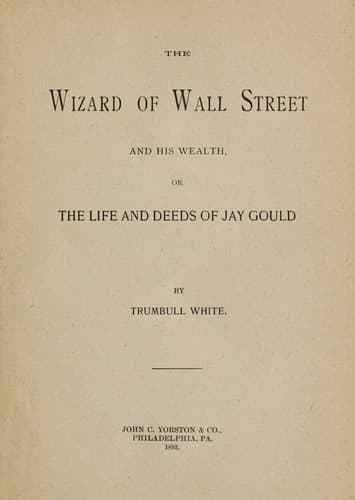
The Wizard of Wall Street and His Wealth; or, The Life and Deeds of Jay GouldWhite, Trumbull
History
The Wizard of Wall Street and His Wealth; or, The Life and Deeds of Jay Gould
White, Trumbull
Businessmen -- United States -- Biography; Capitalists and financiers -- United States -- Biography; Gould, Jay, 1836-1892
to the receivership, $3,260,519.23, leaving $500,000 still due; as
the grand result of the receivership of Humphreys and Tutt, interest
has accrued to the amount of $4,390,000, all due and unpaid, and of
receivers’ obligations, $3,200,000, a total during two years and a half
of $7,590,000, with $290,000 of cash in hand. The property being sold
to a purchasing committee, of which the chairman, Joy, was a former
Wabash director, and another member, Ashley, was the secretary of the
receivers, a demand was made of the prior mortgage bondholders to
fund into new Wabash bonds their past due interest and to reduce the
interest on their bonds for the future from 6 and 7 per cent. to 5 per
cent. Upon application of prior mortgage bondholders the United States
Circuit Court at Chicago removed Humphreys and Tutt for misconduct as
receivers and appointed a new and separate receiver for the Wabash
lines east of the Mississippi river.”
This removal was upon order of Judge Gresham, who has made such a
high reputation as a judge who can be depended upon not to be easily
influenced in favor of corporations. This order was called at the time
“one of the bravest acts in the history of justice.” On rendering
decision he spoke in terms of great severity of the managers and the
Gould receivers, and appointed in place of the latter Judge Cooley,
who was afterward made railroad commissioner by President Cleveland.
In commenting on this decision, Gould defended himself by attacking
Gresham, who he declared was suffering from a severe attack of “the
presidential fever.”
The Gould purchase of the Missouri Pacific railway has a refreshing
novelty in it on account of the manner in which it was bought. The road
was owned in 1880 by Commodore Garrison, who was not friendly to Mr.
Gould. The latter sent Russell Sage to find out how much the commodore
would take for his interest in the Missouri Pacific. The commodore
said that $2,000,000 would be about right. Sage offered $1,500,000
and Garrison shook his head brusquely. The next day Sage returned and
offered to close the bargain at $2,000,000. “No,” said the commodore,
“the price has advanced to $2,800,000.”
Public-domain text, read in full here on John Shaqi.
Reviews
Reviews
No reviews yet
Be the first to share your thoughts on this work.
Elsewhere in the archive
Join the Discussion
Join the discussion
Sign in to leave a comment or review.
Sign InorCreate an account