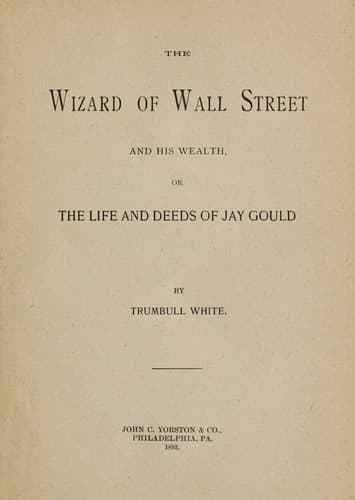
The Wizard of Wall Street and His Wealth; or, The Life and Deeds of Jay GouldWhite, Trumbull
History
The Wizard of Wall Street and His Wealth; or, The Life and Deeds of Jay Gould
White, Trumbull
Businessmen -- United States -- Biography; Capitalists and financiers -- United States -- Biography; Gould, Jay, 1836-1892
One example of Mr. Gould’s finesse in connection with the Western Union
will show his methods. By 1880 his American Union company had become a
constant menace to the other company. Rates to every competing point
had been cut, and his lines reached to the Pacific. Western Union
at one period was up to 116. The wires of the Western Union were
taken from the lines of the Union Pacific and other great railroad
systems controlled by Mr. Gould and those of the American Union were
substituted. The stock of the older corporation fell to 88. It was said
at the time that Mr. Gould was short 30,000 shares of Western Union,
and if that was so he made $840,000.
But in 1881 Mr. Gould and his associates had practically secured
control of the Western Union. It was proposed to sell and transfer
the entire assets and property of the American Union and the American
and Pacific to the Western Union directors. Rufus Hatch, as a
stockholder of the American Union, obtained an injunction restraining
the consolidation, but on February 4, 1881, Judge Barrett refused to
continue the injunction, and by the time he had concluded his opinion
the papers were drawn up, the consolidation was ratified by the
directors of the three companies, and almost before the country knew it
there was one telegraph company where there had been three before.
The stock of the Western Union Telegraph Company was at once “watered”
$40,000,000, or thirty-seven per cent. and Mr. Gould became the leading
spirit in that company, directing its affairs from his offices, which
were in that building.
Nothing Mr. Gould ever did in his life so arrayed public sentiment
against him as this creation of the telegraphic monopoly. Eventually
the Western Union acquired the Baltimore and Ohio telegraph, which
Robert Garrett was glad to sell in order to get money to help the
Baltimore and Ohio railroad out of the difficulties into which it had
fallen.
Repeated efforts were made by the stockholders of the American Union
to secure the interference of the attorney-generals of various states,
but the consolidation stood. In May, 1882, the Western Union secured
control of all the European cables, and no little comment was aroused
soon thereafter when it was charged that Mr. Gould was making an effort
to secure control of the New York Associated Press, or, at least,
of the news which it sent out. He was reputed to control at that
time three of the seven newspapers constituting the corporation, and
something of a sensation was caused by the charge. The Western Union’s
control of the cables became so absolute that the Mackay-Bennett cables
were laid and gave a competing service to Europe, which was afterward
largely extended to other parts of the world.
Public-domain text, read in full here on John Shaqi.
Reviews
Reviews
No reviews yet
Be the first to share your thoughts on this work.
Elsewhere in the archive
Join the Discussion
Join the discussion
Sign in to leave a comment or review.
Sign InorCreate an account