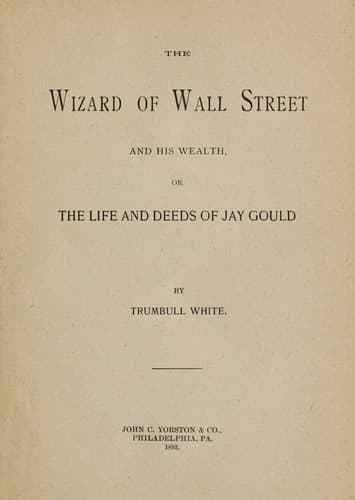
The Wizard of Wall Street and His Wealth; or, The Life and Deeds of Jay GouldWhite, Trumbull
History
The Wizard of Wall Street and His Wealth; or, The Life and Deeds of Jay Gould
White, Trumbull
Businessmen -- United States -- Biography; Capitalists and financiers -- United States -- Biography; Gould, Jay, 1836-1892
In probably no other country of the world would one man be permitted to
control its telegraph system. But Gould became the absolute dictator
of the Western Union and successfully overcame every competitor that
arose. His record in Western Union, like that in his other properties,
is that of a tremendous increase of securities. Like the wicked
milkman, Gould always skimmed off the cream and poured water into
all his properties. The comic papers delighted to picture him with a
watering-pot in his hand.
The mainspring of the Western Union is monopoly. Its condition is such
that it cannot exist with profit to its stockholders with a strong
competition in the field. Thus it is a grand aggregation of small
companies. It has absorbed and will probably continue to absorb every
rival in the field. Gould himself rode into control on the back of a
competing company. This was early in 1881. His version of the story is
given in his testimony to the Senate Committee on Labor and Education.
“I am interested in the telegraph,” he told the committee, “for the
railroad and telegraph systems go hand in hand, as it were, integral
parts of a great civilization. I naturally became acquainted with the
telegraph business and gradually became interested in it. I thought
well of it as an investment, and I kept increasing my interests. When
the Union Pacific was built I had an interest in a company called the
Atlantic and Pacific, and I endeavored to make that a rival to the
Western Union. We extended it considerably, but found it rather uphill
work. We saw that our interest lay more with the Western Union. Through
that we could reach every part of the country, and through a small
company we could not; so we made an offer to sell to Western Union the
control of the Atlantic and Pacific. At that time a very dear friend of
mine was the manager, and I supposed that he would be made the manager
of the Western Union; but after the consolidation was perfected it was
not done, and I made up my mind that he should be at the head of as
good a company as I had taken him from. The friend was Gen. Eckert,
and for him I started another company, the American Union--and we
carried it forward until a proposition was made to merge it also into
the Western Union. As the stock of the latter went down, I bought a
large interest in it, and found that the only way out was to put the
two companies together. Gen. Eckert became general manager of the whole
system. Meantime, I bought so much of its property and its earning
power that I have kept increasing my interest. I thought it better to
let my income go into the things that I was in myself, and I have never
sold any of my interests, but have devoted my income to increasing
them. This is the whole history of it.”
Public-domain text, read in full here on John Shaqi.
Reviews
Reviews
No reviews yet
Be the first to share your thoughts on this work.
Elsewhere in the archive
Join the Discussion
Join the discussion
Sign in to leave a comment or review.
Sign InorCreate an account