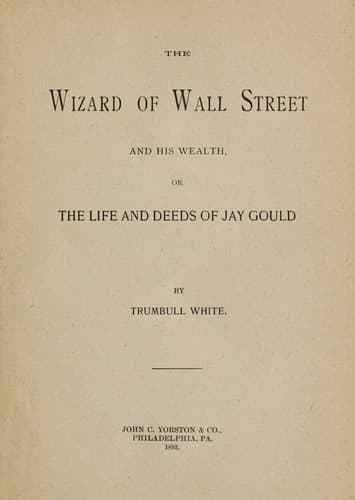
The Wizard of Wall Street and His Wealth; or, The Life and Deeds of Jay GouldWhite, Trumbull
History
The Wizard of Wall Street and His Wealth; or, The Life and Deeds of Jay Gould
White, Trumbull
Businessmen -- United States -- Biography; Capitalists and financiers -- United States -- Biography; Gould, Jay, 1836-1892
Field began his business life as a rag
merchant, but with indomitable pluck, energy and foresight he finally
succeeded in constructing the first Atlantic cable, and was honored
both in London and New York. Mr. Field sought almost equal distinction
in connection with the elevated railroads, whose great importance
he comprehended, and he made a bid for popularity by insisting on a
reduction of the fares from 10 to 5 cents against the wishes of Gould
and Sage. Sage first became acquainted with Gould in Troy. Field first
became identified with him in 1879, when he (Field) was president of
the Wabash railroad, though we have seen him as a guest at the famous
banquet given to President Grant on “Jim” Fisk’s steamboat in 1869.
Mr. Gould turned his attention to the elevated railroads in this city
early in 1881. The Manhattan company was then in control of all the
lines as lessee, and to Mr. Gould’s keen vision that company presented
the appearance of being on the verge of financial disaster. The
Manhattan company had issued $13,000,000 of stock--pure water--and had
divided the same equally between the Metropolitan and the New York
companies. There was much criticism of the action of the Manhattan
corporation in issuing so large a quantity of stock which was wholly
unrepresented by property. The attorney-general of this state, Hamilton
Ward, obtained permission from Judge Donohue, May 18, 1881, to begin
a suit for the dissolution of the Manhattan company’s charter and the
appointment of a receiver. Other suits were begun about the same time
to restrain the Manhattan company from paying any dividends on its
stock. Of course these suits tended to depress Manhattan stock in the
stock market.
Gould, Sage and Field agreed together to consolidate the three
elevated railroad companies. They were, however, met by the determined
opposition of President Kneeland, of the Metropolitan road. Nothing
could induce him to waver in his opposition. His associates in the
Metropolitan deserted him, and one by one they went over to Gould, but
he stood firm to the very last, and his persistency caused a celebrated
litigation, which proved so protracted and costly that Kneeland was
finally defeated, though his spirit was unsubdued.
Public-domain text, read in full here on John Shaqi.
Reviews
Reviews
No reviews yet
Be the first to share your thoughts on this work.
Elsewhere in the archive
Join the Discussion
Join the discussion
Sign in to leave a comment or review.
Sign InorCreate an account