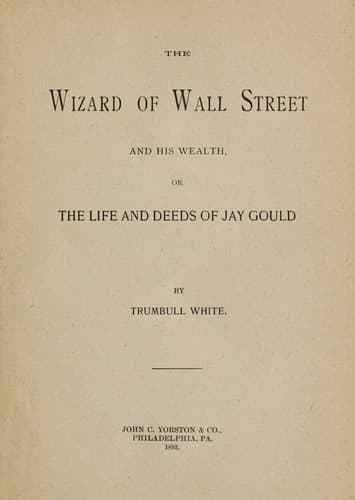
The Wizard of Wall Street and His Wealth; or, The Life and Deeds of Jay GouldWhite, Trumbull
History
The Wizard of Wall Street and His Wealth; or, The Life and Deeds of Jay Gould
White, Trumbull
Businessmen -- United States -- Biography; Capitalists and financiers -- United States -- Biography; Gould, Jay, 1836-1892
Gould, naturally enough, came into control of this great system, which
carries 600,000 passengers every day, through a consolidation and the
“watering” of stock. There were three elevated roads--the Metropolitan
(formerly the “Gilbert,” named after its originator, Dr. Gilbert), of
which S. H. Kneeland was president; the second, the New York, of which
Cyrus W. Field was president and of which Samuel J. Tilden was once a
heavy stockholder, and the third, the Manhattan, of which Jay Gould
and Russell Sage were the owners. The Metropolitan and the New York
were bona-fide companies, actually owning railroads and rolling stock,
but the Manhattan was a “paper” company, having a nominal charter and
an organization, but not one inch of road. Yet these three companies
were consolidated on equal terms, and Gould, Sage and Field became the
owners. Later the control narrowed down to Gould and Sage.
Sage, Field and Kneeland are remarkable characters in Wall street
history, and their names are intimately identified with Gould’s--Sage
and Field as associates, and Kneeland as an unpurchasable opponent.
Russell Sage is one of the richest men of his generation. He came
originally from Troy, where he ran a bank, and whose district he
represented in Congress, before the war, for one or two terms. Then
he entered Wall street. His great distinguishing trait was avarice.
He worshipped the mighty dollar. Money-getting was his passion--not
for the power and luxury which money can purchase, but for the mere
pleasure of acquisition. He lived, it is true, on Fifth avenue, and
gave somewhat to charity, but his habits were economical almost to the
point of penuriousness, and once a dollar got into his hands it did
not easily slip through them. It should be said of him, however, that
he was as careful of other people’s money as of his own. This was the
man who for many years was Gould’s most intimate business associate, a
director in all his companies and a partner in all his schemes. Gould
estimated Sage’s wealth at $50,000,000 and their combined capital was
thus enormous. Sage was chiefly a money-lender in Wall street. He
carried an immense amount of ready cash and was of incalculable aid
to Gould in all his undertakings. It is indeed one of the traditions
of the street that Sage saved Gould from ruin at a time when he was
hotly pressed by James R. Keene and other bear operators. Field was
a different kind of a man. He liked money but only as a means to an
end, and he had not the heart or mind to roll up a colossal fortune
in the way that Gould and Sage did, though he shared for a time in
their enterprises. But at one time he was worth millions. Field’s
passion was love of fame. His brothers all gained distinction in the
professions; he sought and obtained distinction in commercial life.
One of his brothers sat on the Supreme Bench of his country. Another
was a leader of the New York Bar. A third was a noted clergyman,
editor and traveler. Cyrus W.
Public-domain text, read in full here on John Shaqi.
Reviews
Reviews
No reviews yet
Be the first to share your thoughts on this work.
Elsewhere in the archive
Join the Discussion
Join the discussion
Sign in to leave a comment or review.
Sign InorCreate an account