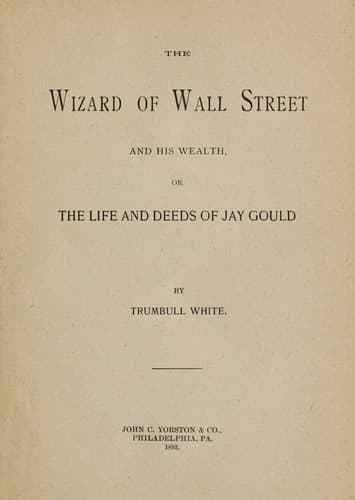
The Wizard of Wall Street and His Wealth; or, The Life and Deeds of Jay GouldWhite, Trumbull
History
The Wizard of Wall Street and His Wealth; or, The Life and Deeds of Jay Gould
White, Trumbull
Businessmen -- United States -- Biography; Capitalists and financiers -- United States -- Biography; Gould, Jay, 1836-1892
For a while after Mr. Gould got control of the Manhattan company there
was some show of fight between him and Cyrus W. Field, who represented
the stockholders of the New York company. Soon Gould, Field and Sage
came together and had an amicable understanding. An opinion was
obtained from Judge Westbrook, who held court in Jay Gould’s private
office, denying the application of the New York company to get its
road out of the hands of the Manhattan company, and in the latter
part of October the Gould-Field-Sage party entered into an agreement
in behalf of the three companies by which the Manhattan stockholders
were to receive only 6 per cent. dividend on their stock instead of 10
per cent. Next came an order from Judge Westbrook taking the Manhattan
company out of the hands of the receivers, and that corporation, which
was absolutely under Gould’s control, proceeded to rivet its hold upon
the entire elevated railway system of this city. Immediately following
Judge Westbrook’s action the Manhattan stock went above 52, and on
November 9th, the day that Jay Gould was elected president of the
company, the stock was quoted at 55.
The steps which Gould and his associates took to “freeze out” the
original stockholders of the Metropolitan company were exposed by the
New York _Times_ in a series of articles beginning in December, 1881,
and continuing until the Legislature ordered a special investigation
into the matter in April, 1882. Specific charges were made against
Hamilton Ward, as attorney general, and Justice Theodoric R. Westbrook
of the Supreme Court for their part in the elevated railroad
proceedings, and the Judiciary Committee of the Assembly spent several
weeks in taking testimony. Jay Gould and others were examined, and
letters and telegrams from Judge Westbrook to Gould’s lawyers were
produced in evidence, showing that Westbrook had a very friendly
understanding with Mr. Gould. It was also proved that on two occasions
Judge Westbrook exercised his judicial functions in Gould’s private
office. The committee was divided in its conclusions and Westbrook just
escaped impeachment. The effective lessons of the exposure and the
official investigation, however, put a stop to further “freeze-out”
tactics in dealing with the honest stockholders of the Metropolitan
Elevated Railroad Company. Those who had refused to be shaken off by
the bearish assaults on the property finally received satisfactory
compensation for their property from Mr. Gould and his associates.
Public-domain text, read in full here on John Shaqi.
Reviews
Reviews
No reviews yet
Be the first to share your thoughts on this work.
Elsewhere in the archive
Join the Discussion
Join the discussion
Sign in to leave a comment or review.
Sign InorCreate an account