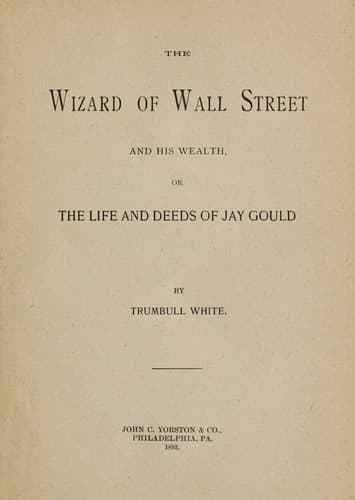
The Wizard of Wall Street and His Wealth; or, The Life and Deeds of Jay GouldWhite, Trumbull
History
The Wizard of Wall Street and His Wealth; or, The Life and Deeds of Jay Gould
White, Trumbull
Businessmen -- United States -- Biography; Capitalists and financiers -- United States -- Biography; Gould, Jay, 1836-1892
After obtaining full control of the elevated railroad system, Gould
and his associates voted to double the capital stock, making it
$26,000,000. In opposing the reduction of the fare from 10 cents to
5 cents, they argued that a 5 cent fare would not enable them to pay
dividends on their $26,000,000. A member of the Senate committee
suggested that they might reduce their capitalization. Mr. Field
became identified with all of Mr. Gould’s properties, but gave most
of his attention to the development of the elevated roads. In 1886
he inaugurated the big bull movement in Manhattan stock. He “boomed”
the stock in every possible way, and bought immense quantities, and
publicly predicted that it would sell at 200. He succeeded in pushing
the price to 175. Like almost all artificial corners this movement
collapsed suddenly and Mr. Field was nearly buried in the ruins.
Many believed at the time that this collapse was precipitated by
Gould and Sage. It might have come about by other causes, but Gould
gave the tottering structure the push that leveled it to the ground.
There were many reasons, it was argued, for his action. First, Field
was no longer necessary, but on the contrary a hindrance to Gould
and Sage, and they therefore wanted to get rid of him; and second,
Field was conducting his bull movement independently of them. They
would profit by his fall, while if he succeeded the system might pass
into his hands. So in June, 1887, came the collapse. Mr. Field never
charged Gould with having precipitated it, and Gould himself claimed
that he came to the rescue of Field and saved him from bankruptcy. It
was, however, a remarkable deal and one by which Gould made himself
absolutely master of the elevated system, of which in 1891 he made
his eldest son vice-president, and another son a director. Field was
carrying an immense amount of stock on margins and was consequently a
heavy borrower of money. Gould and Sage were lenders. The bank reserves
were low. Gould and Sage called in their loans and Gould found it
impossible to negotiate loans and was thus obliged to throw over his
stock at a sacrifice. The price of Manhattan fell from 160 to 120 and
Gould purchased from Field 78,000 shares at prices understood to have
ranged from par to 120. Field saved his real estate and other property,
but his power in the street was gone. His later history was a tragedy.
In 1891, within a few weeks, he lost his wife and his son became a
disgraced bankrupt. A few months ago Field died, broken hearted.
CHAPTER XIII.
THE LIFE OF A WALL STREET KING.
While it is true that the story of Jay Gould’s career in Wall street is
closely allied with his outside operations, a full account of which has
already been given, there still remain many other incidents connected
directly with his work on the street of unusual interest. Out of this
mass of material but two or three incidents of the most commanding
interest can be used.
Public-domain text, read in full here on John Shaqi.
Reviews
Reviews
No reviews yet
Be the first to share your thoughts on this work.
Elsewhere in the archive
Join the Discussion
Join the discussion
Sign in to leave a comment or review.
Sign InorCreate an account