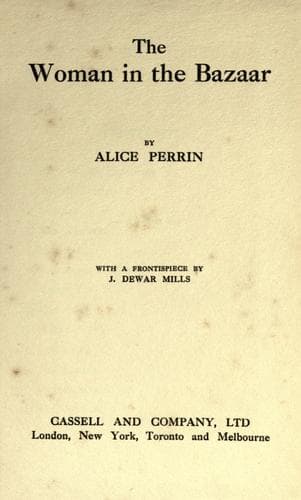
British -- India -- Fiction; India -- Social life and customs -- Fiction
The stall was soon cleared, and tea tickets sold well--sixpence a head
for the affluent in the vicarage dining-room, twopence for the more
humble out in the garden at a long trestle table in charge of the
schoolmaster's wife. It was not until most of the throng had departed
that Coventry found a chance of speaking with Rafella alone. He ignored
the timid remarks of his sister concerning the time, her fears that
"mother might feel fatigued or take cold if they remained too late"; and
he calmly requested Miss Forte to show him the kitchen garden.
"There is not much to see, I'm afraid," Rafella said shyly, yet willing
enough to take him.
"The very sight of an English kitchen garden is refreshing to anyone
from India," he informed her; and they wandered off together, leaving
Mr. Forte to entertain Mrs. Coventry and her daughter and one or two
lingering visitors in the faded, old-fashioned drawing-room.
Truly there was little to see, beyond cabbages and gooseberry bushes,
and the cherished potato patch, in the kitchen garden; the box borders
had grown high and thick, and sadly needed trimming. There was an empty
greenhouse, frequented by toads, and in one corner stood a shaky
summer-house, suggestive of earwigs and spiders, dust and cobwebs.
But to Coventry it was a garden of glamour and dreams. For him a
delicious enchantment hung in the air, an infinite pleasure pervaded his
being; he wondered how long it must be before he might dare to proclaim
his passion, before he might hold this dear girl in his arms as his
promised wife.
"How would you like to go to India?" he asked her, dallying with the
prospect of taking her there, visualising her bright presence in his
bungalow.
"India! Oh, I don't know," she said, surprised. "I have never thought of
going anywhere."
"But--but you will marry some day," he suggested tentatively, "and then
you will have to go away."
She blushed and laughed a little nervously.
"Oh, that is not at all likely; and even if it were, how could I leave
my father? He has become so dependent on me since my darling mother's
death."
His spirits sank. He had forgotten all about her father, and the filial
sense of duty that would, of course, prevail with such a dear, good
girl. He resigned himself to the prospect of struggle, opposition;
nevertheless, he meant to win, though in the end the marriage might have
to be delayed for a reasonable period.
"But your father would never stand in the way of your happiness,
surely?" he argued.
"I shouldn't be happy," she maintained, "if I thought I was behaving
selfishly."
"Of course, to a certain extent you are right," he agreed; "but, after
all, there are limits to unselfishness. Every woman has a just claim to
her own existence." (In the case of his sister this view had not
occurred to him.)
"Do you think so?" she asked doubtfully, in deference to his superior
masculine wisdom.
Public-domain text, read in full here on John Shaqi.
Reviews
Reviews
No reviews yet
Be the first to share your thoughts on this work.
Join the Discussion
Join the discussion
Sign in to leave a comment or review.
Sign InorCreate an account