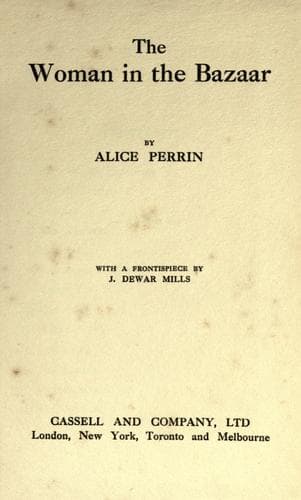
British -- India -- Fiction; India -- Social life and customs -- Fiction
The wedding took place a fortnight before Coventry was to sail for
India. One or two trivial disputes arose between the affianced pair, and
on each occasion George's will prevailed. For example over the
trousseau. It appeared that Rafella was entitled, on her twenty-first
birthday, or on her marriage, to the legacy of a hundred pounds
bequeathed to her by her godmother. She maintained that the half of this
sum would be ample for her outfit, and she was on the point of engaging
the village dressmaker to work daily at the vicarage, when George
interfered. Though he did not wish Rafella to be anything but simply
dressed, he had a suspicion that Under-edge fashions might be regarded
as somewhat peculiar in an Indian military station. Therefore he
insisted that her "costumes," as she called them, should at least be
ordered in the little country town, under the guidance of his mother and
sister, in whose taste he had implicit confidence. The result enchanted
all concerned, though certainly it might have evoked contempt on the
part of the more fastidious.
At any rate, in Coventry's eyes, and in the opinion of all present at
the wedding, Rafella looked lovely as a bride; and, indeed, it was a
very pretty ceremony, altogether, in its idyllic simplicity. The autumn
day was radiant with sunshine, the kind of day when spiders' webs hang
sparkling and perfect, as though spun with tiny crystal beads, and the
air is still and humid; when the foliage, all red and gold, strikes
wonder, and the blackberries are ripe and round and purple. The little
church was decked with brilliant leaves and berries, and the pews were
as well filled as if it had been Christmas Day. Not that any formal
invitations had been issued; the only wedding guests from any distance
were the bridegroom's near relations (he had few besides), and the
bride's only aunt, who had consented to come and live at the vicarage
and to join her small income to that of her brother. But the entire
village was present in Sunday garments, save those who were bedridden
and had been left without compunction to take care of themselves for the
time. Rafella's only aunt did successful battle with the unwilling
harmonium, and with much solemn emotion the vicar married his daughter
to Captain Coventry.
It may be added that the bridegroom also had his way, after all, about
the hymn, and it was sung by the congregation with a raucous fervour
that stirred George Coventry to the depths of his being, for he could
not help investing the words with a personal application, in spite of
Rafella's previous protests to the contrary.
Public-domain text, read in full here on John Shaqi.
Reviews
Reviews
No reviews yet
Be the first to share your thoughts on this work.
Join the Discussion
Join the discussion
Sign in to leave a comment or review.
Sign InorCreate an account