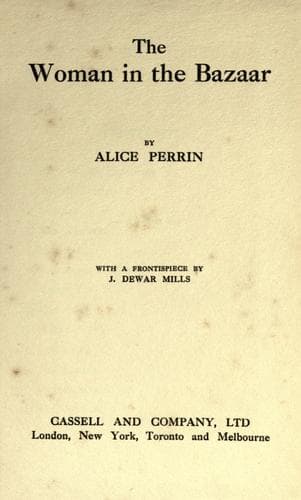
British -- India -- Fiction; India -- Social life and customs -- Fiction
"She seems happy. He's very good-looking, and she admires him." Mrs.
Munro spoke helplessly. Then she reached behind her and took from a
small table a silver-framed photograph of a man in uniform--just the
head and shoulders--a stern, handsome face, with close-cropped grey hair
and grave, keen eyes.
Mrs. Greaves regarded it intently. "He has grown better-looking with
age," she remarked. "He looks like an elderly hero in a play. I dare say
he might take a young girl's fancy." As she handed the photograph back
to Ellen Munro she espied another photograph on the table, that of a
young man, cheerful, impudent, boyish.
"What will Guy say when he hears of Trixie's engagement, I wonder?"
"What should he say? There was nothing between him and Trixie, and never
could have been. They both knew that quite well."
"All the same, it is fortunate, perhaps, that she is not going to
India."
"But she _is_ going to India," said Mrs. Munro desperately. "George
takes up command of that battalion next month, and he wants Trixie to be
ready to go with him. She is quite willing."
"Ah!" exclaimed Mrs. Greaves significantly; and Trixie's mother sat
silent, in rueful understanding.
Guy Greaves, Colonel Greaves's nephew, was a subaltern in the battalion
of the Barchesters now serving in India, and it was through him,
indirectly, that Trixie had met the man she had promised to marry. Some
people might have imagined that she was more likely to marry the
subaltern than the colonel, until that youth left England, glum and
miserable; and there was one young man the less to go with Trixie and
her friends to teas and dances and theatres--outings he could ill
afford, "broke," as he had always declared himself, "to the world."
Presently Mrs. Munro said: "What could I do, except refuse my consent
until Trixie was of age? Of course, I had to consent. I felt I had no
right to raise objections that could only be indefinite. As you know, we
have nothing but our pensions, and it is a galling life to a girl of
Trixie's temperament. Colonel Coventry has private means, and his
character is unimpeachable. There are no drawbacks beyond his age and
his sad story."
Mrs. Munro's voice trembled; she was almost at the end of her endurance,
and she began to cry in the silent, helpless manner peculiar to women of
her down-trodden type. All her life she had been sacrificed to somebody;
first to her brother, who had been considered in every way before
herself; then to her husband's mother and sisters, since the greater
part of Mr. Munro's pay had gone home towards their support, and he had
died before he could save anything for his wife and child; and then to
Trixie, who had always had what she wanted as far as the widow's slender
means would permit, and of late had been "such a handful," to quote Mrs.
Greaves and various other of the mother's old friends.
Public-domain text, read in full here on John Shaqi.
Reviews
Reviews
No reviews yet
Be the first to share your thoughts on this work.
Join the Discussion
Join the discussion
Sign in to leave a comment or review.
Sign InorCreate an account