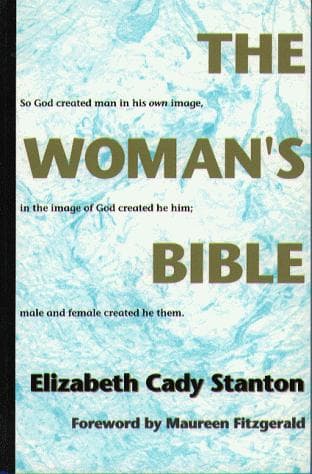
Bible -- Commentaries; Bible -- Feminist criticism; Women in the Bible
In the early chapters of this book Moses' praises of Hebrew valor in
marching into a land already occupied and utterly destroying men, women
and children, seems much like the rejoicing of those who believe in
exterminating the aboriginees in America. Evidently Moses believed in
the survival of the fittest and that his own people were the fittest.
He teaches the necessity of exclusiveness, that the hereditary traits
of the people may not be lost by intermarriage. Though the Israelites,
like the Puritans, had notable foremothers as well as forefathers, yet
it was not the custom to mention them. Perhaps the word fathers meant
both, as the word man in Scripture often includes woman. In the preface
by Lord Bishop Ely, to what is popularly known as the Speaker's Bible,
the remark is made that "whilst the Word of God is one, and does not
change, it must touch at new points the changing phases of physical,
philological and historical knowledge, and so the comments that suit
one generation are felt by another to be obsolete." So, also, it is
that with the higher education of women, their wider opportunities and
the increasing sense of justice, many interpretations of the Bible are
felt to be obsolete, hence the same reason exists for the Woman's
Commentary, which is already popularly known as the Woman's Bible.
Deuteronomy is a name derived from the Greek and signifies that this
is the second or duplicate law, because this, the last book of the
Pentateuch, consists partly in a restatement of the law,
as already given in other books. Deuteronomy contains also, besides
special commands and advice not previously written, an account of the
death of Moses. Johnson's Universal Cyclopedia states that "the
authority of this book has been traditionally assigned to Moses, but,
of course, the part relating to his death is not supposed to be written
by himself, and indeed the last four chapters may have been added by
another hand." DeWette declares that Moses could not have been the
author. He not only points to the closing chapters as containing proof,
but he refers to the anachronisms in earlier chapters, and insists that
the general manner in which the Mosaic history is treated belongs to a
period after the time of Moses. And Rev. John White Chadwick in his
"Bible of To-day" declares that "Prophetism created Deuteronomy." He
speaks of Malachi, the last of the Prophets, as the first to mention
the Mosaic law, and says that in the eighth century before Christ there
was no Mosaic law in any modern sense. The Pentateuch in anything like
its present form was still far in the future. Deuteronomy more than a
hundred years ahead. Leviticus and Numbers nearly three hundred. * * *
The book of Deuteronomy was much more of a manufacture than any
previous portion of the Pentateuch. * * * Not Sinai and Wilderness, but
Babylon and Jerusalem, witnessed the promulgation of the Levitical law.
Its priest was Ezra and not Aaron; but who was its Moses the most
Public-domain text, read in full here on John Shaqi.
Reviews
Reviews
No reviews yet
Be the first to share your thoughts on this work.
Elsewhere in the archive
Join the Discussion
Join the discussion
Sign in to leave a comment or review.
Sign InorCreate an account