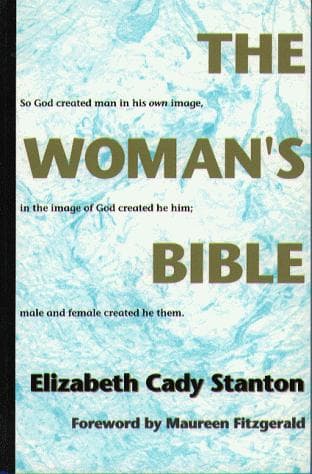
Bible -- Commentaries; Bible -- Feminist criticism; Women in the Bible
An outline of a subject so vast and profound as the nature and meaning
of the Pentateuch, must necessarily be more or less unsatisfactory. It
cannot be detached from the rest of the Bible which is a complete
organic body. Its meaning is consecutive and harmonious with first
premises, from beginning to end. The obvious inconsistencies and
absurdities involve only its letter, which may or may not be true as
history without affecting the truth of the book itself which lies in
its meaning.
The projectors of "The Woman's Bible" must not avoid the whirlpool of
a masculine Bible only, to split upon the rock of a feminine Bible
alone. This would be an attempt to separate what is intensely joined
together and defeat the end desired. The book is the soul's guide in
the fulfilling of its destiny--that destiny which is involved in its
origin; and the soul, in sleep, is sexless. Its faculties and powers
are differentiated are masculine and feminine.
If the question is asked--"What is your authority for this view of the
Bible?" the answer is "I have none but the internal evidence of the
book itself. When joined it is self-evident truth, requiring no
external authority to give it support."
U. N. G.
APPENDIX.
As the Revising Committee refer to a woman's translation of the Bible
as their ultimate authority, for the Greek, Latin and Hebrew text, a
brief notice of this distinguished scholar is important:
Julia Smith's translation of the Bible stands out unique among all
translations. It is the only one ever made by a woman, and the only
one, it appears, ever made by man or woman without help. Wyclif, "the
morning star of the Reformation," made a translation from the Vulgate,
assisted by Nicholas of Hereford. He was not sufficiently familiar with
Hebrew and Greek to translate from those tongues. Coverdale's
translation was not done alone. In his dedication to the king he says
he has humbly followed his interpreters and that under correction.
Tyndale, in his translation, had the assistance of Frye, of William
Roye, and also of Miles Coverdale. Julia Smith translated the whole
Bible absolutely alone, without consultation with any one. And this not
once, but five times--twice from the Hebrew, twice from the Greek and
once from the Latin. Literalness was one end she kept constantly in
view, though this does not work so well with the Hebrew tenses. But she
did not mind that. Frequently her wording is an improvement, or brings
one closer to the original than the common translation. Thus in I.
Corinthians viii, 1, of the King James translation, we have: "Knowledge
puffeth up, but charity edifieth." Julia Smith version: "Knowledge
puffs up and love builds the house." She uses "love" in place of
"charity" every time. And her translation was made nearly forty years
before the revised version of our day, which also does the same.
Tyndale, in his translation nearly three hundred and seventy-five years
Public-domain text, read in full here on John Shaqi.
Reviews
Reviews
No reviews yet
Be the first to share your thoughts on this work.
Elsewhere in the archive
Join the Discussion
Join the discussion
Sign in to leave a comment or review.
Sign InorCreate an account