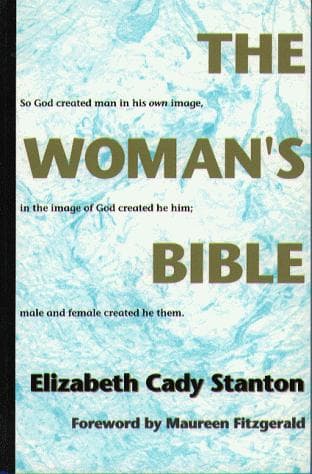
Bible -- Commentaries; Bible -- Feminist criticism; Women in the Bible
Theological odium has laid its hand heavily upon her. "This odium," as
a Rev. D. D. once said to the writer, "is a thing with more horns, more
thorns, more quills and more snarls than almost any other sort of thing
you have ever heard of. It has kindled as many fires of martyrdom; it
has slipnoosed as many ropes for the necks of well-meaning men; it has
built as many racks for the dislocation of human bones; it has forged
as many thumbscrews; it has built as many dungeons; it has ostracised
as many scholars and philosophers; it has set itself against light and
pushed as hard to make the earth revolve the other way on its axis, as
any other force of mischief of whatever name or kind."
And that is the fearful thing with which woman has had to contend.
When she is free from it we may be assured that the dawn of a new day
is not far off. And among the indications pointing that way is the fact
that the Bible itself has been "under treatment" for some time. What is
known as the "Higher Criticism" has done much to clear away the clouds
of superstition which have enveloped it.
One of the latest works on this line is "The Polychrome Bible"--the
word meaning the different colors in which the texts, the notes, the
dates, the translations, etc., are printed for the sake of simplifying
matters. Prof. Paul Haupt, of Johns Hopkins University, is at the head
of this great work, ably assisted by a large corps of the best Biblical
scholars in the world. It is not to be a revision of the accepted
version, but a new translation in modern English. The translation is
not to be literal except in the highest sense of the word, viz., "to
render the sense of the original as faithfully as possible." There are
to be explanatory notes, historical and archaelogical illustrations of
the text, paraphrases of difficult passages, etc. In short, everything
possible is to be done to simplify and to make plain this ancient book.
The contributors have instructions not to hesitate to state what they
consider to be the truth, but with as little offence to the general
reader as possible. This work has been pronounced the greatest literary
undertaking of the century--a work which will prepare the way for the
coming generation to give an entirely new consideration to the
religious problem. It was begun in 1890, and will probably not be
completed before 1900.
Public-domain text, read in full here on John Shaqi.
Reviews
Reviews
No reviews yet
Be the first to share your thoughts on this work.
Elsewhere in the archive
Join the Discussion
Join the discussion
Sign in to leave a comment or review.
Sign InorCreate an account