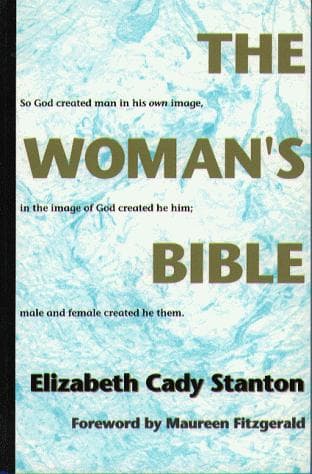
Bible -- Commentaries; Bible -- Feminist criticism; Women in the Bible
It was Eve's curse that her desire should be to her husband, and he
should rule over her. Have you not seen her clinging to a drunken or
brutal husband, and read in letters of fire upon her forehead her
curse? But God did not say the curse was good, nor bid Adam enforce it.
Nor did he say, all men shall rule over thee. For Adam, not Eve, the
earth was to bring forth the thorn and the thistle, and he was to eat
his bread by the sweat of his brow. Yet I never heard a sermon on the
sin of uprooting weeds, or letting Eve, as she does, help him to bear
his burden. It is when she tries to lighten her load that the world is
afraid of sacrilege and the overthrow of nature.
C. B. C.
In the story "of the sons of God, and the daughters of men"--we find a
myth like those of Greek, Roman and Scandinavian fable, demi-gods love
mortal maidens and their offspring are giants. Then follows the
traditional account of some great cataclysm of the last glacial epoch.
According to the latest geological students, Wright, McGee and others;
the records of Niagara, the falls of St. Anthony and other glacial
chasms, indicate that the great ice caps receded for the last time
about seven thousand years ago; the latest archeological discoveries
carry our historical knowledge of mankind back nearly four thousand
years B. C., so that some record of the mighty floods which must have
followed the breaking of great glacial dams might well survive in the
stories of the nations.
Abram who came from Ur of the Chaldees brought with him the Chaldean
story of the flood. At that time Ur, now a town fifty miles inland, was
a great seaport of the Persian gulf. Their story of the flood is that
of a maritime people; in it the ark is a well built ship, Hasisadra,
the Chaldean Noah takes on board not only his own family, but his
neighbors and friends; a pilot is employed to guide the course, and
proper provision is made for the voyage. A raven and a dove are sent
out as in the biblical account, and a fortunate landing effected.
L. D. B.
CHAPTER VI.
Genesis xxi.
1 And the lord visited Sarah as he had said.
2. For Sarah bare Abraham a son in his old age.
3 And Abraham called the name of his son whom Sarah bare to him, Isaac.
5 And Abraham was a hundred years old, when his son Isaac was born
unto him.
6 And Sarah said, God hath made me to laugh, so that all that hear
will laugh with me.
9 And Sarah saw the son of Hagar the Egyptian, which she had home
unto Abraham, mocking.
10 Wherefore she said unto Abraham, Cast out this bondwoman and her
son; for the son of this bondwoman shall not be heir with my son, even
with Isaac.
11 And the thing was very grievous in Abraham's sight.
12 And God said unto Abraham, Let it not be grievous in thy sight;
in all that Sarah hath said unto thee, hearken unto her voice; for in
Isaac shall thy seed be called.
13 And also of the son of the bondwoman will I make a nation, because
he is thy seed.
Public-domain text, read in full here on John Shaqi.
Reviews
Reviews
No reviews yet
Be the first to share your thoughts on this work.
Join the Discussion
Join the discussion
Sign in to leave a comment or review.
Sign InorCreate an account