Bible -- Commentaries; Bible -- Feminist criticism; Women in the Bible
The plain English to the ordinary mind admits of no such liberal
interpretation. The unvarnished texts speak for themselves. The canon
law, church ordinances and Scriptures, are homogeneous, and all
reflect the same spirit and sentiments.
These familiar texts are quoted by clergymen in their pulpits, by
statesmen in the halls of legislation, by lawyers in the courts, and
are echoed by the press of all civilized nations, and accepted by woman
herself as "The Word of God." So perverted is the religious element in
her nature, that with faith and works she is the chief support of the
church and clergy; the very powers that make her emancipation
impossible. When, in the early part of the Nineteenth Century, women
began to protest against their civil and political degradation, they
were referred to the Bible for an answer. When they protested against
their unequal position in the church, they were referred to the Bible
for an answer.
This led to a general and critical study of the Scriptures. Some,
having made a fetish of these books and believing them to be the
veritable "Word of God," with liberal translations, interpretations,
allegories and symbols, glossed over the most objectionable features of
the various books and clung to them as divinely inspired. Others,
seeing the family resemblance between the Mosaic code, the canon law,
and the old English common law, came to the conclusion that all alike
emanated from the same source; wholly human in their origin and
inspired by the natural love of domination in the historians. Others,
bewildered with their doubts and fears, came to no conclusion. While
their clergymen told them on the one hand, that they owed all the
blessings and freedom they enjoyed to the Bible, on the other, they
said it clearly marked out their circumscribed sphere of action: that
the demands for political and civil rights were irreligious, dangerous
to the stability of the home, the state and the church. Clerical
appeals were circulated from time to time, conjuring members of their
churches to take no part in the anti-slavery or woman suffrage
movements, as they were infidel in their tendencies, undermining the
very foundations of society. No wonder the majority of women stood
still, and with bowed heads, accepted the situation.
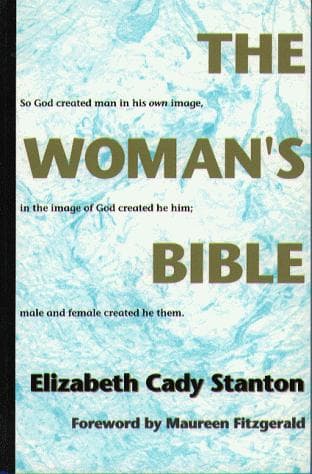
Listening to the varied opinions of women, I have long thought it
would be interesting and profitable to get them clearly stated in book
form. To this end six years ago I proposed to a committee of women to
issue a Woman's Bible, that we might have women's commentaries on
women's position in the Old and New Testaments. It was agreed on by
several leading women in England and America and the work was begun,
but from various causes it has been delayed, until now the idea is
received with renewed enthusiasm, and a large committee has been
formed, and we hope to complete the work within a year.
Public-domain text, read in full here on John Shaqi.
Reviews
Reviews
No reviews yet
Be the first to share your thoughts on this work.
Join the Discussion
Join the discussion
Sign in to leave a comment or review.
Sign InorCreate an account