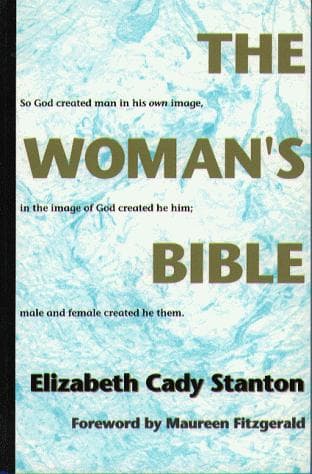
Bible -- Commentaries; Bible -- Feminist criticism; Women in the Bible
Even as mere history the life and character of Sarah certainly do not
intimate that it was the Divine plan that woman was to be a
subordinate, either in person or in her home. Taken esoterically, as
all ancient Oriental writings must be to get their full significance,
it is an inspiration to woman to-day to stand for her liberty. The
bondwoman must be cast out. All that makes for industrial bondage, for
sex slavery and humiliation, for the dwarfing of individuality, and for
the thralldom of the soul, must be cast out from our home, from
society, and from our lives. The woman who does not claim her
birthright of freedom will remain in the wilderness with the children
that she has borne in degradation, heart starvation, and anguish of
spirit, only to find that they are Ishmaels, with their hand against
every man. They will be the subjects of Divine care and protection
until their destiny is worked out. But she who is to be the mother of
kings must herself be free, and have surroundings conducive to
maintaining her own purity and dignity. After long ages of freedom
shall have eradicated from woman's mind and heart the thought habits of
the slave, then will she be a true daughter of Sarah, the Princess.
C. B. C.
Abraham has been held up as one of the model men of sacred history.
One credit he doubtless deserves, he was a monotheist, in the midst of
the degraded and cruel forms of religion then prevalent in all the
oriental world; this man and his wife saw enough of the light to
worship a God of Spirit. Yet we find his conduct to the last degree
reprehensible. While in Egypt in order to gain wealth he voluntarily
surrenders his wife to Pharaoh. Sarah having been trained in subjection
to her husband had no choice but to obey his will. When she left the
king, Abraham complacently took her back without objection, which was
no more than he should do seeing that her sacrifice had brought him
wealth and honor. Like many a modern millionaire he was not a self-made
but a wife-made man. When Pharaoh sent him away with his dangerously
beautiful wife he is described as, "being rich in cattle, in silver and
in gold," but it is a little curious that the man who thus gained
wealth as the price of his wife's dishonor should have been held up as
a model of all the patriarchal virtues.
L. D. B.
CHAPTER VII.
Genesis xxiv.
37 And my master made me swear, saying, Thou shall not take a wife to
my son of the daughters of the Canaanites in whose land I dwell.
38 But thou shalt go unto my fathers house, and to my kindred, and
take a wife unto my son.
39 And I said unto my master, Peradventure the woman will not follow me.
40 And he said unto me, The Lord, before whom I walk, will send his
angel with thee, and prosper thy way; and thou shalt take a wife for my
son of my kindred, and of my father's house:
42 And I came this day unto the well, and said, O Lord God of my
master Abraham, if now thou do prosper my way which I go:
Public-domain text, read in full here on John Shaqi.
Reviews
Reviews
No reviews yet
Be the first to share your thoughts on this work.
Join the Discussion
Join the discussion
Sign in to leave a comment or review.
Sign InorCreate an account