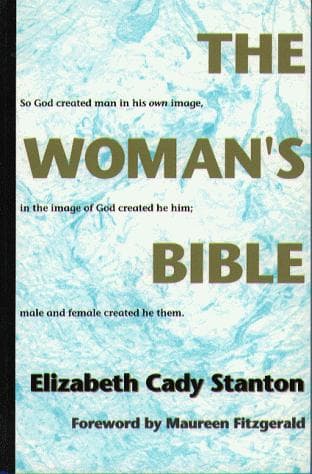
Bible -- Commentaries; Bible -- Feminist criticism; Women in the Bible
We have often wondered that the revising committees that have gone
over these documents so often, should have adhered so closely to such
gross translations. Surely a fact related to us in coarse language, is
not less a fact when repeated in choice, words. We need an expurgated
edition of most of the books called holy before they are fit to place
in the hands of the rising generation.
Some members of the Revising Committee write me that the tone of some
of my comments should be more reverent in criticising the "Word of
God." Does any one at this stage of civilization think the Bible was
written by the finger of God, that the Old and New Testaments emanated
from the highest divine thought in the universe? Do they think that all
the men who wrote the different books were specially inspired, and that
all the various revising committees that have translated, interpolated,
rejected some books and accepted others, who have dug round the roots
of the Greek and Hebrew to find out the true meaning, have one and all
been watched and guided in their literary labors by the great spirit of
the universe, who by immutable law holds the solar system in place,
every planet steadily moving in its own elliptic, worlds upon worlds
revolving in order and harmony?
These great object-lessons in nature and the efforts of the soul to
fathom the incomprehensible, are more inspiring than any written page.
To this "Word of God" I bow with reverence, and I can find no language
too exalted to express my love, my faith, my admiration.
To criticise the peccadilloes of Sarah, Rebekah and Rachel does not
shadow the virtues of Deborah, Huldah and Vashti; to condemn the laws
and customs of the Jews as recorded in the book of Genesis, does not
destroy the force of the golden rule and the ten commandments. Parts of
the Bible are so true, so grand, so beautiful, that it is a pity it
should have been bound in the same volume with sentiments and
descriptions so gross and immoral.
E. C. S.
CHAPTER XI.
Genesis xxxv.
8 But Deborah Rebekah's nurse died, and she was buried beneath Beth-el
under an oak; and the name of it was called Allonbachuth.
9 And God appeared unto Jacob again, when he came out of Padan-aram,
and blessed him.
10 And God said unto him, Thy name is Jacob: Thy name shall not be
called any more Jacob, but Israel shall be thy name: and he called his
name Israel.
16 And they journeyed from Beth-el; and there was but a little way
to come to Ephrath: and Rachel travailed, and she had hard labor.
17 The midwife said unto her, Fear not; thou, shalt have this son also.
18 And it came to pass as her soul was in departing (for she died),
that she called his name Ben-oni; but his father called him Benjamin.
19 And Rachel died, and was buried in the way to Ephrath, which is
Beth-lehem.
20 And Jacob set a pillar upon her grave: that is the pillar of
Rachel's grave unto this day.
Public-domain text, read in full here on John Shaqi.
Reviews
Reviews
No reviews yet
Be the first to share your thoughts on this work.
Join the Discussion
Join the discussion
Sign in to leave a comment or review.
Sign InorCreate an account