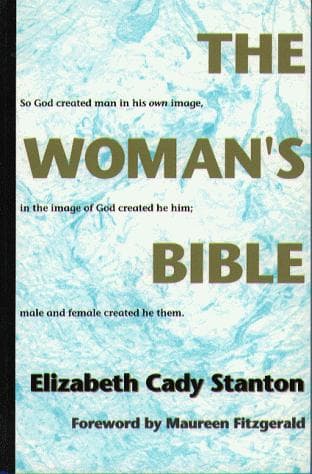
Bible -- Commentaries; Bible -- Feminist criticism; Women in the Bible
In several of the following chapters the sins of men and women are
treated on equal grounds, hence they need no special comments. In
reading many of these chapters we wonder that an expurgated edition of
these books was not issued long ago. We trust the volume we propose to
issue may suggest to the next Revising Committee of gentlemen the
propriety of omitting many texts that are gross and obscene, especially
if the Bible is to be read in our public schools.
Leviticus x.
12 And Moses spake unto Aaron, and unto Eleazar and unto Ithamar,
his sons that were left, Take the meat offering that remaineth of the
offerings of the Lord made by fire, and eat it without leaven beside
the altar: for it is most holy.
13 And ye shall eat it in the holy place, because it is thy due, and
thy sons' due, of the sacrifices of the Lord made by fire: for so I am
commanded.
14 And the wave breast and heave shoulder shall ye eat in a clean
place; thou, and thy sons, and thy daughters with thee: for they be thy
due, and thy sons' due, which are given out of the sacrifices of peace
offerings of the children of Israel.
Why the daughters cannot eat with the sons in the thirteenth verse and
may in the fourteenth we cannot conjecture. We notice, however, that
where the sons eat alone is called a "holy place," where the daughters
eat with them it is called simply a "clean place." We are thankful,
however, that in the distribution of meats the women come in
occasionally for a substantial meal in a
clean place.
All the directions given in the eighteenth chapter are for men and
women alike, for all nations and all periods of human development. The
social habits and sanitary conditions prescribed are equally good for
our times as when given by Moses to the children of Israel. The virtue
of cleanliness so sedulously taught cannot be too highly commended.
E. C. S.
CHAPTER II.
Leviticus xix.
3 If ye shall fear every man his mother, and his father, and keep my
sabbaths: I am the Lord your God.
20 If And whosoever cohabits with a bondmaid, betrothed to a husband,
and not at all redeemed, nor freedom given her; she shall be scourged:
they shall not be put to death, because she was not free.
21 And he shall bring his trespass offering unto the Lord, unto the
door of the tabernacle of the congregation, even a ram for a trespass
offering.
22 And the priest shall make an atonement for him with the ram of the
trespass offering before the Lord for his sin which he hath done: and
the sin which he hath done shall be forgiven him.
By what possible chance the mother is mentioned first here, it is
difficult to conjecture, but we do see the cruel injustice of the
comparative severity of the punishment for man and woman for the same
offence. The woman is scourged, the man presents the priest with a ram
and is forgiven.
Leviticus xx.
Public-domain text, read in full here on John Shaqi.
Reviews
Reviews
No reviews yet
Be the first to share your thoughts on this work.
Elsewhere in the archive
Join the Discussion
Join the discussion
Sign in to leave a comment or review.
Sign InorCreate an account