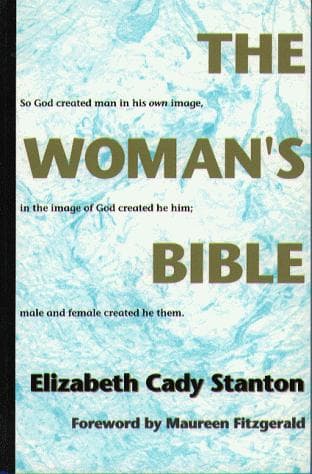
Bible -- Commentaries; Bible -- Feminist criticism; Women in the Bible
The injunctions of St. Paul have had such a decided influence in
fixing the legal status of women that it is worth our while to consider
their source. In dealing with this question we must never forget that
the majority of the writings of the New Testament were not really
written or published by those whose names they bear. Ancient writers
considered it quite permissible for a man to put out letters under the
name of another, and thus to bring his own ideas before the world under
the protection of an honored sponsor. It is not usually claimed that
St. Paul was the originator of the great religious movement called
Christianity, but there is a strong belief that he was divinely
inspired. His inward persuasions, and especially his visions appeared
as a gift or endowment which had the force of inspiration; therefore,
his mandates concerning women have a strong hold upon the popular mind,
and when opponents to the equality of the sexes are put to bay they
glibly quote his injunctions.
We congratulate ourselves that we may shift some of these biblical
arguments that have such a sinister effect from their firm foundation.
He who claims to give a message must satisfy us that he has himself
received such message.
L. S.
CHAPTER V.
Numbers xxvii.
1 Then came the daughters of Zelophehad, the son of Hepher, the son of
Gilead, the son of Machir, the son of Manasseh, of the families of
Manasseh, the son of Joseph; and these are the names of his daughters:
Mahiah, Noah, and Hogiah, and Milcah, and Tirzah.
2 And they stood before Moses, and before Eleazar the priest, and
before the princes and all the congregation, by the door of the
tabernacle of the congregation, saying,
3 Our father died in the wilderness, and he was not in the company of
them that gathered themselves together again at the Lord in the company
of Korah.
4 Why should the name of our father be done away from among his
family, because he hath no son? Give us therefore a possession among
the brethren of our father.
5 And Moses brought their cause before the Lord.
6 And the Lord spake unto Moses, saying,
7 The daughters of Zelophehad speak right thou shalt surely give them
a possession of an inheritance among their father's brethren; and thou
shalt cause the inheritance of their father to pass unto them.
8 And thou shalt speak unto the children of Israel, saving, If a man
die, and have no son, then ye shall cause his inheritance to pass unto
his daughter.
9 And if he have no daughter, then ye shall give his inheritance unto
his brethren.
10 And if he have no brethren, then ye shall give his inheritance unto
his father's brethren.
11 And if his father have no brethren, then ye shall give his
inheritance unto his kinsman that is next to him of his family, and he
shall possess it; and it shall be unto the children of Israel a statute
of judgment, as the Lord commanded Moses.
Public-domain text, read in full here on John Shaqi.
Reviews
Reviews
No reviews yet
Be the first to share your thoughts on this work.
Elsewhere in the archive
Join the Discussion
Join the discussion
Sign in to leave a comment or review.
Sign InorCreate an account