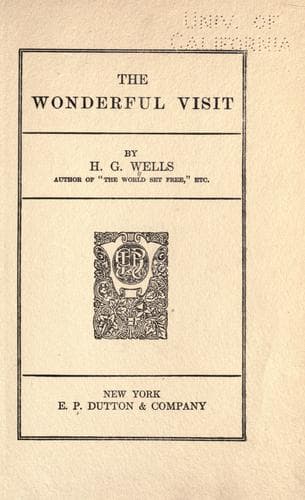
Angels -- Fiction; England -- Social life and customs -- 19th century -- Fiction; Fantasy fiction
The study and the realities of life suddenly faded out of the Vicar's
eyes, grew thinner and thinner like a mist that dissolves into air, and
he and the Angel stood together on a pinnacle of wrought music, about
which glittering melodies circled, and vanished, and reappeared. He was
in the land of Beauty, and once more the glory of heaven was upon the
Angel's face, and the glowing delights of colour pulsated in his wings.
Himself the Vicar could not see. But I cannot tell you of the vision of
that great and spacious land, of its incredible openness, and height,
and nobility. For there is no space there like ours, no time as we know
it; one must needs speak by bungling metaphors and own in bitterness
after all that one has failed. And it was only a vision. The wonderful
creatures flying through the æther saw them not as they stood there,
flew through them as one might pass through a whisp of mist. The Vicar
lost all sense of duration, all sense of necessity----
"Ah!" said the Angel, suddenly putting down the fiddle.
The Vicar had forgotten the book on Political Economy, had forgotten
everything until the Angel had done. For a minute he sat quite still.
Then he woke up with a start. He was sitting on the old iron-bound
chest.
"Really," he said slowly, "you are very clever."
He looked about him in a puzzled way. "I had a kind of vision while you
were playing. I seemed to see----. What did I see? It has gone."
He stood up with a dazzled expression upon his face. "I shall never play
the violin again," he said. "I wish you would take it to your room--and
keep it----. And play to me again. I did not know anything of music
until I heard you play. I do not feel as though I had ever heard any
music before."
He stared at the Angel, then about him at the room. "I have never felt
anything of this kind with music before," he said. He shook his head. "I
shall never play again."
THE ANGEL EXPLORES THE VILLAGE.
XXIV.
Very unwisely, as I think, the Vicar allowed the Angel to go down into
the village by himself, to enlarge his ideas of humanity. Unwisely,
because how was he to imagine the reception the Angel would receive? Not
thoughtlessly, I am afraid. He had always carried himself with decorum
in the village, and the idea of a slow procession through the little
street with all the inevitable curious remarks, explanations, pointings,
was too much for him. The Angel might do the strangest things, the
village was certain to think them. Peering faces. "Who's _he_ got now?"
Besides, was it not his duty to prepare his sermon in good time? The
Angel, duly directed, went down cheerfully by himself--still innocent of
most of the peculiarities of the human as distinguished from the angelic
turn of mind.
Public-domain text, read in full here on John Shaqi.
Reviews
Reviews
No reviews yet
Be the first to share your thoughts on this work.
Join the Discussion
Join the discussion
Sign in to leave a comment or review.
Sign InorCreate an account