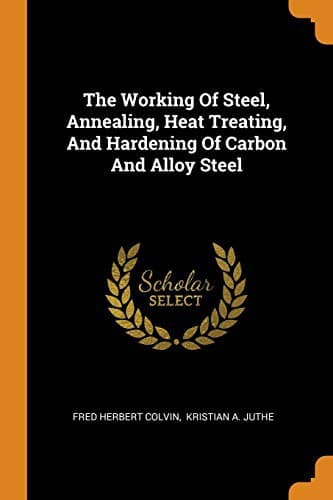
The Working of Steel: Annealing, Heat Treating and Hardening of Carbon and Alloy SteelColvin, Fred H. (Fred Herbert)
Science
The Working of Steel: Annealing, Heat Treating and Hardening of Carbon and Alloy Steel
Colvin, Fred H. (Fred Herbert)
Steel
Approximate
Grades carbon range Common uses
Extra soft 0.08-0.18 Pipe, chain and other welding purposes;
(dead soft) case-hardening purposes; rivets; pressing
and stamping purposes.
Structural (soft) 0.15-0.25 Structural plates, shapes and bars for
(medium) bridges, buildings, cars, locomotives;
boiler (flange) steel; drop forgings; bolts.
Medium 0.20-0.35 Structural purposes (ships); shafting;
automobile parts; drop forgings.
Medium hard 0.35-0.60 Locomotive and similar large forgings; car
axles; rails.
Hard 0.60-0.85 Wrought steel wheels for steam and electric
railway service; locomotive tires; rails;
tools, such as sledges, hammers, pick points,
crowbars, etc.
Spring 0.85-1.05 Automobile and other vehicle springs; tools,
such as hot and cold chisels, rock drills
and shear blades.
Spring 0.90-1.15 Railway springs; general machine shop tools.
CHAPTER II
COMPOSITION AND PROPERTIES OF STEEL
It is a remarkable fact that one can look through a dozen text
books on metallurgy and not find a definition of the word "steel."
Some of them describe the properties of many other irons and then
allow you to guess that everything else is steel. If it was difficult
a hundred years ago to give a good definition of the term when the
metal was made by only one or two processes, it is doubly difficult
now, since the introduction of so many new operations and furnaces.
We are in better shape to know what steel is than our forefathers.
They went through certain operations and they got a soft malleable,
weldable metal which would not harden; this they called iron. Certain
other operations gave them something which looked very much like
iron, but which would harden after quenching from a red heat. This
was steel. Not knowing the essential difference between the two,
they must distinguish by the process of manufacture. To-day we
can make either variety by several methods, and can convert either
into the other at will, back and forth as often as we wish; so
we are able to distinguish between the two more logically.
Public-domain text, read in full here on John Shaqi.
Reviews
Reviews
No reviews yet
Be the first to share your thoughts on this work.
Join the Discussion
Join the discussion
Sign in to leave a comment or review.
Sign InorCreate an account