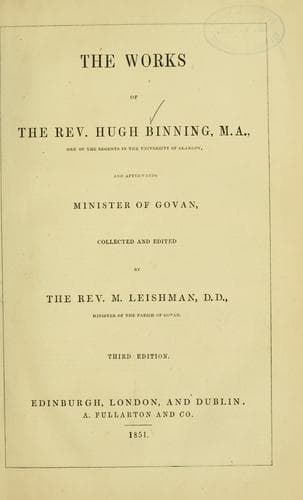
Presbyterian Church -- Sermons; Sermons, English; Theology -- Early works to 1800; Theology -- History -- 17th century
always love in it to such persons; and therefore he is come near in
Christ, and about reconciling us to himself. Here is the business then, to
have our souls reconciled to him, to take away the enmity within us, and
as he is satisfied with his Son, so to satisfy ourselves with him, and be
as well-pleased in his redemption and purchase as the Father is, and then
you believe indeed in him. Now if this were accomplished, what have we
more to do but to love him and to live to him? When you have found in the
Scripture, and believed with the heart, what man once was, and what he now
is, what God once appeared, and what he now manifests himself in the
gospel, ye have no more to do but to search in the same Scriptures what ye
henceforth ought to be. Ye who find your estate recovered in Christ, ask,
“What manner of persons ought we to be?” And the Scripture shall also give
you that “form of sound words,” which may not only teach you to believe in
him, but to love him and obey his commands. The law that before condemned
you is now by Christ put in your hands to guide you and conduct you in the
way, and teacheth you how to live henceforth to his glory. “The grace of
God that bringeth salvation hath appeared unto all men, reaching us, that
denying ungodliness, and worldly lusts, we should live soberly,
righteously, and godly in this present world,” Tit. ii. 12. Here is the
sum of the rule of your practice and conversation, piety towards God,
equity towards men, and sobriety towards ourselves; self-denial, and world
denial, and lust-denial, to give up with the world and our own
lusts,—henceforth to have no more to do with them,—to resign them, not for
a time, not in part, but wholly and for ever in affection, and by parts in
practice and endeavour; and then to resign and give up ourselves to him,
to live to him, and to live in him.
Thus we have given you a sum of the doctrine of the Scriptures, of that
which is to be believed, and that which is to be done as our duty. Now we
shall speak a word of these two cardinal graces which are the compend of
all graces,—as the objects of them are the abridgment of the
Scriptures,—faith and love. These “sound words” can profit us nothing,
unless we hold them fast with faith and love.
Public-domain text, read in full here on John Shaqi.
Reviews
Reviews
No reviews yet
Be the first to share your thoughts on this work.
Elsewhere in the archive
Join the Discussion
Join the discussion
Sign in to leave a comment or review.
Sign InorCreate an account